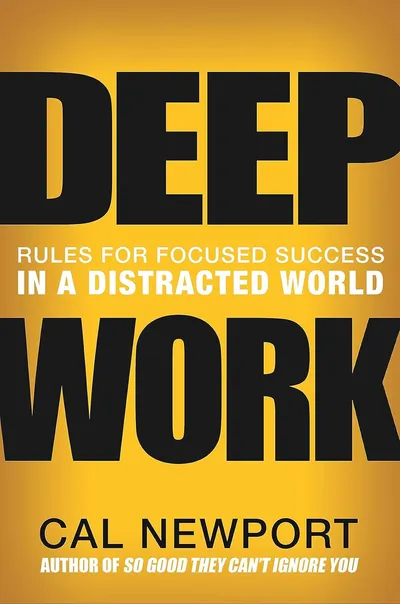
Key Takeaway
Deep work, the ability to focus without distraction on cognitively demanding tasks, is becoming both rarer and more valuable at exactly the same time. Master it and you have an unfair advantage over everyone competing for the same outcomes.
The Big Picture
- Deep work produces disproportionate results compared to shallow, fragmented effort
- Most knowledge workers have structured their days around the exact opposite of what produces their best output
- Focus is a skill that atrophies without practice, you have to train it like a muscle
Why This Book Matters For Your Day-to-Day Life
I read this book during a period where I was “busy” all the time but had nothing meaningful to show for it. Emails, Slack, meetings, context-switching, my days were full but felt empty. I was in motion but not taking action, to borrow James Clear’s distinction.
Newport made me realize that the problem wasn’t time management. It was attention management. I had plenty of hours. I just couldn’t go deep on anything because I’d fractured my focus into dozens of shallow fragments.
What makes this book hit different in 2026 is the AI angle. Claude can write code, draft emails, generate reports, all the shallow work that used to fill our days. But it can’t do the deep thinking that produces truly original work. The people who can sustain focused attention on hard problems are going to be worth exponentially more than the people who outsource their thinking to tools.
Newport basically predicted this years before the AI wave. The ability to do deep work isn’t just a productivity hack. It’s becoming the most valuable professional skill you can develop.
Core Concepts
The Deep Work Hypothesis
Newport’s central claim: the ability to perform deep work is becoming increasingly rare at the exact same time it’s becoming increasingly valuable in our economy. Those who cultivate this ability will thrive. Those who don’t will fall behind.
This isn’t just theory. He backs it with examples across fields, from Carl Jung building a stone tower in the woods to write, to Bill Gates taking “Think Weeks” where he’d isolate himself with nothing but papers and books. The pattern is consistent: exceptional output comes from exceptional focus.
I think about this whenever I feel the pull to check my phone mid-task. That pull isn’t harmless. It’s training my brain to avoid sustained attention, the exact muscle I need most.
Shallow Work vs. Deep Work
Newport defines shallow work as logistical-style tasks that don’t require much cognitive effort and can be performed while distracted, emails, scheduling, most meetings, administrative tasks.
Deep work is the opposite: professional activities performed in a state of distraction-free concentration that push your cognitive capabilities to their limit.
The problem is that most of us fill our days with shallow work and convince ourselves we’re being productive because we’re “busy.” I was guilty of this for years. Responding to 50 emails feels productive. But those emails rarely move the needle on anything that actually matters.
Here’s the uncomfortable question Newport forces you to ask: if you tallied your work hours last week, how many were genuinely deep? For most people, the answer is shockingly low.
The Four Rules of Deep Work
Rule 1: Work Deeply
Structure your day to protect blocks of uninterrupted focus. Newport describes four philosophies:
- Monastic: Eliminate almost all shallow obligations (unrealistic for most people)
- Bimodal: Dedicate specific days or weeks entirely to deep work
- Rhythmic: Schedule deep work at the same time every day (this is what I do)
- Journalistic: Fit deep work wherever you can in an unpredictable schedule
I settled on the rhythmic approach. Every morning before anything else, no phone, no email, no Slack, I do my most cognitively demanding work. The consistency matters more than the duration. Even 90 minutes of protected deep work each morning has compounded dramatically.
Rule 2: Embrace Boredom
This one stung. Newport argues that if every moment of boredom is filled with a stimulus, scrolling, podcasts, checking notifications, you’re training your brain to never tolerate the discomfort of sustained attention.
The implication: your off-hours matter as much as your work hours. If you can’t sit in a waiting room without reaching for your phone, don’t expect to sustain three hours of focused writing.
I started small, leaving my phone in another room during meals, walking without earbuds, sitting with my coffee for 10 minutes without any screen. It felt unbearable at first. That’s how I knew it was working.
Rule 3: Quit Social Media
Newport isn’t anti-technology. He’s anti-distraction masquerading as connection. His framework: only use a tool if its positive impacts on the things you value substantially outweigh the negatives.
I didn’t quit everything, but I did a ruthless audit. Deleted apps from my phone that I was using out of habit rather than intention. The result: more mental clarity and zero regret about what I “missed.”
This pairs naturally with Digital Minimalism, which is essentially the full-length expansion of this rule.
Rule 4: Drain the Shallows
Quantify and constrain the shallow work in your schedule. Newport suggests: ask yourself, “How long would it take to train a recent college graduate to do this task?” If the answer is short, it’s shallow work.
The goal isn’t to eliminate shallow work entirely, some is necessary. The goal is to prevent it from crowding out the work that actually matters.
What I’ve Found Most Useful
The morning deep work ritual: Protecting the first hours of my day for deep work has been transformative. Before I adopted this, I’d start my day reactively, checking messages, responding to requests, and by noon I’d have nothing to show for it. Now my best work happens before most people are online.
The “productive meditation” technique: Newport suggests using time you’d otherwise waste (commuting, walking, showering) to think deeply about a specific problem. Not passively daydreaming, but actively holding one problem in your mind and working through it. I’ve solved more creative problems on walks than at my desk.
The shutdown ritual: At the end of each workday, Newport does a complete shutdown, reviewing tasks, making a plan for tomorrow, then saying “shutdown complete” out loud. It sounds silly but it works. It gives your brain permission to stop working, which means your off-hours actually recharge you instead of being half-work.
The attention residue concept: When you switch from Task A to Task B, part of your attention stays stuck on Task A. This “attention residue” means you’re never fully present on what you’re doing if you keep switching. Understanding this single concept made me restructure how I approach my entire workday.
Memorable Quotes
“Who you are, what you think, feel, and do, what you love, is the sum of what you focus on.”
“If you don’t produce, you won’t thrive, no matter how skilled or talented you are.”
“Two Core Abilities for Thriving in the New Economy: 1. The ability to quickly master hard things. 2. The ability to produce at an elite level, in terms of both quality and speed.”
“The key to developing a deep work habit is to move beyond good intentions and add routines and rituals to your working life designed to minimize the amount of your limited willpower necessary to transition into and maintain a state of unbroken concentration.”
Final Thoughts
The most counterintuitive thing about deep work is that doing less, fewer tasks, fewer meetings, fewer context switches, produces more. Not just more output, but better output.
In a world where AI can do shallow work faster than any human, the ability to go deep becomes the thing that actually differentiates you. Not your productivity app. Not your note-taking system. Your capacity to sit with a hard problem until it breaks open.
That capacity isn’t a talent. It’s a skill you build through practice and protect through structure.
Build the structure. Protect the time. The depth will follow.