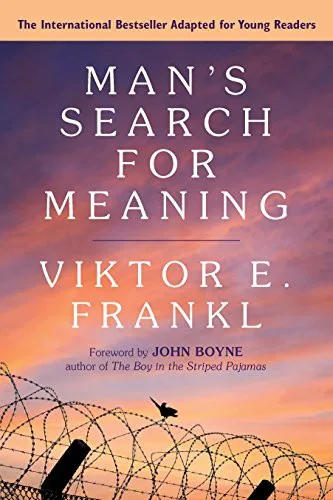
Man's Search for Meaning
Key Takeaway
Between what happens to you and how you respond, there’s a space, and in that space lives your entire freedom.
The Big Picture
- Suffering is unavoidable, but meaning can be found in any situation, even the worst imaginable
- The people who survived the concentration camps weren’t the strongest physically, but the ones who held onto a reason to live
- You don’t find meaning by asking what you want from life, you find it by asking what life wants from you
Why This Book Matters For Your Day-to-Day Life
I’ll be honest, I almost didn’t finish this book. Not because it was bad, but because the first half is brutal. Frankl describes his time in Auschwitz with a level of clinical detachment that somehow makes it more devastating. He watched friends die. He was stripped of everything, clothes, possessions, dignity, name. Reduced to a number.
And yet this is where the core insight lives. In the absolute worst conditions a human being can experience, Frankl noticed something: the prisoners who survived weren’t necessarily the toughest. They were the ones who had something to live for. A child waiting at home. A manuscript to finish. A person to see again. Purpose kept them alive when everything else had been taken.
Here’s the thing: most of us will never face anything remotely close to a concentration camp. But we face our own versions of the existential vacuum every day. That feeling when you’re doing everything “right”, good job, decent paycheck, checking the boxes, and still feeling hollow inside. I know that feeling. I lived in it for years during my nursing career. On paper, I had a respectable path. In reality, I was running someone else’s script, and the emptiness was getting louder.
Frankl would call that the existential vacuum, what happens when you have freedom and comfort but no purpose. It’s the autopilot life. You’re moving but you’re not going anywhere you chose. And the scary part is you can fill that vacuum with all kinds of distractions, scrolling, spending, drinking, staying “busy”, without ever addressing the actual void.
When I finally made the pivot away from nursing and toward building something of my own, the discomfort didn’t disappear. It actually got worse for a while. But it was a different kind of discomfort, the kind that comes with choosing your own meaning instead of borrowing someone else’s. Frankl would say that’s exactly the point. Meaning isn’t found in comfort. It’s found in the struggle you choose.
Core Concepts
Logotherapy. Meaning as the Primary Drive
Freud said we’re driven by pleasure. Adler said power. Frankl said meaning. That’s the foundation of logotherapy, the idea that the primary motivational force in humans isn’t to feel good or to dominate, but to find a reason for existing.
This reframing changes everything about how you approach a bad day, a career setback, or a season of suffering. Instead of asking “how do I make this stop?” you ask “what is this asking of me?”
I think about this when I’m grinding through the unglamorous parts of building a business. The parts nobody posts about. The meaning isn’t in the result, it’s in the fact that I chose this difficulty. Nobody forced me to build something from scratch. That choice is the meaning.
The Last Human Freedom
Frankl’s most famous insight: “Everything can be taken from a man but one thing: the last of the human freedoms, to choose one’s attitude in any given set of circumstances.”
Read that again.
This isn’t toxic positivity. Frankl isn’t saying “just think positive.” He watched people die. He’s saying that even when every external freedom is stripped away, you still have the internal freedom to decide what your suffering means. That’s the one thing no one can take from you.
I think of this as the ultimate form of programming your own mind. Your circumstances are the input. Your response is the code you write. And no one else gets to write that code for you, unless you let them. In a world where AI can handle most of the “what”, what to write, what to build, what to optimize, this freedom to choose your why becomes the most human thing about you.
Tragic Optimism
This concept doesn’t get enough attention. Frankl describes tragic optimism as the ability to maintain hope despite, and even because of, the tragic elements of human existence: pain, guilt, and death.
It’s not optimism that ignores reality. It’s optimism that looks directly at suffering and says “yes, and I will find meaning anyway.”
Bill Perkins talks about optimizing your life for experiences and minimal regret in Die With Zero. Frankl goes deeper. He’s saying you can find meaning not just in peak experiences, but in the painful ones too. The experience of helping my parents retire wasn’t just a financial milestone, it was meaning built from years of choosing a harder path when easier ones were available. The struggle was the meaning.
What I’ve Found Most Useful
The “Sunday neurosis” diagnosis: Frankl noticed that many people became depressed on Sundays, not because anything bad happened, but because the absence of work revealed the absence of meaning. I use this as a personal diagnostic. If I dread unstructured time, something is off with my purpose alignment. If I’m excited by open space, I’m on the right track. It’s like a free weekly check-in on whether you’re living with intention or running on autopilot.
Dereflection, stop overthinking yourself: Frankl’s technique for anxiety is counterintuitive. Instead of focusing on fixing what’s wrong with you, direct your attention outward, toward a task, a person, a cause larger than yourself. I’ve found this shockingly effective. The times I’ve felt most stuck in my own head were the times I was most self-focused. Volunteering, teaching, building something for others, that’s where the anxiety loosens its grip. The Okinawans in Ikigai discovered the same thing. Purpose isn’t found by looking inward endlessly. It’s found by engaging outward.
Meaning through attitude: When you can’t change a situation, you’re challenged to change yourself. I keep coming back to this during seasons where nothing seems to be working. The project isn’t gaining traction. The numbers aren’t moving. The temptation is to spiral. But Frankl’s framework reframes the question from “why is this happening to me?” to “who am I becoming through this?” That’s a fundamentally different, and more useful, question.
Memorable Quotes
“He who has a why to live can bear almost any how.”
“When we are no longer able to change a situation, we are challenged to change ourselves.”
“Everything can be taken from a man but one thing: the last of the human freedoms, to choose one’s attitude in any given set of circumstances, to choose one’s own way.”
Final Thoughts
Most self-help books tell you how to get what you want. This one asks whether you’ve even figured out why you want it.
That’s what makes it different. Frankl isn’t selling a system or a framework or a morning routine. He’s pointing at something more fundamental, the idea that meaning isn’t a luxury you pursue once the bills are paid. It’s the thing that keeps you going while you pay them.
I’ve read a lot of books about purpose. Ikigai gives you a beautiful framework. Csikszentmihalyi’s Flow shows you what it feels like to be fully engaged. But Frankl does something neither of those books do, he proves that meaning can survive the absolute destruction of everything else. That it isn’t dependent on circumstances. That it’s a choice.
And if it’s a choice, that means it’s available to you right now. Not when you hit your revenue goal. Not when you move to the right city. Not when you finally “figure things out.”
Right now.
— filed under purpose

David Vo
Writing about mindset, purpose, money, and building with AI, from Montreal. Breaking free from autopilot, one system at a time.