12 Financial Goals for Your 20s
You don't need a trust fund or the next Amazon. Twelve money goals for your 20s, from someone who bought the extra pair of Yeezys.

Most millionaires didn’t get there on a huge salary.
When Ramsey Solutions surveyed more than 10,000 American millionaires for its National Study of Millionaires, a third of them had never earned six figures in a single year of their careers. Most were self-made, and most live pretty normal lives, nothing like the Hollywood version.
That’s great news for you and me. We don’t need to build the next Amazon to set ourselves up. We can make it without coming from money, and if you’re reading this, I’m guessing you didn’t come from money either. I didn’t.
Your 20s are the learning years. It’s okay to make mistakes, figure out who you are and try new things. Then suddenly you’re 30 and the social clock gets loud: the career, the partner, the wedding, the house (in this market?), maybe kids.
So have a good time in your 20s. Just set a few things up while you do. Here are the 12 money goals I’d chase, and the ones I got wrong.
1. Become financially literate
Nobody teaches you this in school, so you have to teach yourself.
You don’t need a finance degree. You need the basics: how a budget works, how investing works, how credit cards and interest work. Even a basic understanding of those three will save you from most of the expensive mistakes people make in their 20s.
The internet is full of free material, and a couple of good books go a long way. The trick is using what you learn, not just collecting it.
2. Build the habit of saving
It doesn’t matter how much you make if you can’t keep any of it.
Most people don’t fail to save because of their income. They fail because the money arrives, the lifestyle grows to meet it, and there’s nothing left at the end of the month.
Give your savings a job. Maybe it’s investing, a trip, or a down payment on your first place. Then make it automatic: a portion of each paycheck goes straight into savings before you see it. I like 20%. It still gives you room to breathe and live.
3. Make a monthly budget
I was always broke in college, and I couldn’t tell you where my money went. All I knew was that I always came up short. I didn’t even look at my money monthly…
Budgeting is what fixed it. The first time I actually tracked my spending, I found ridiculous costs I didn’t even know I had, and I cut them.
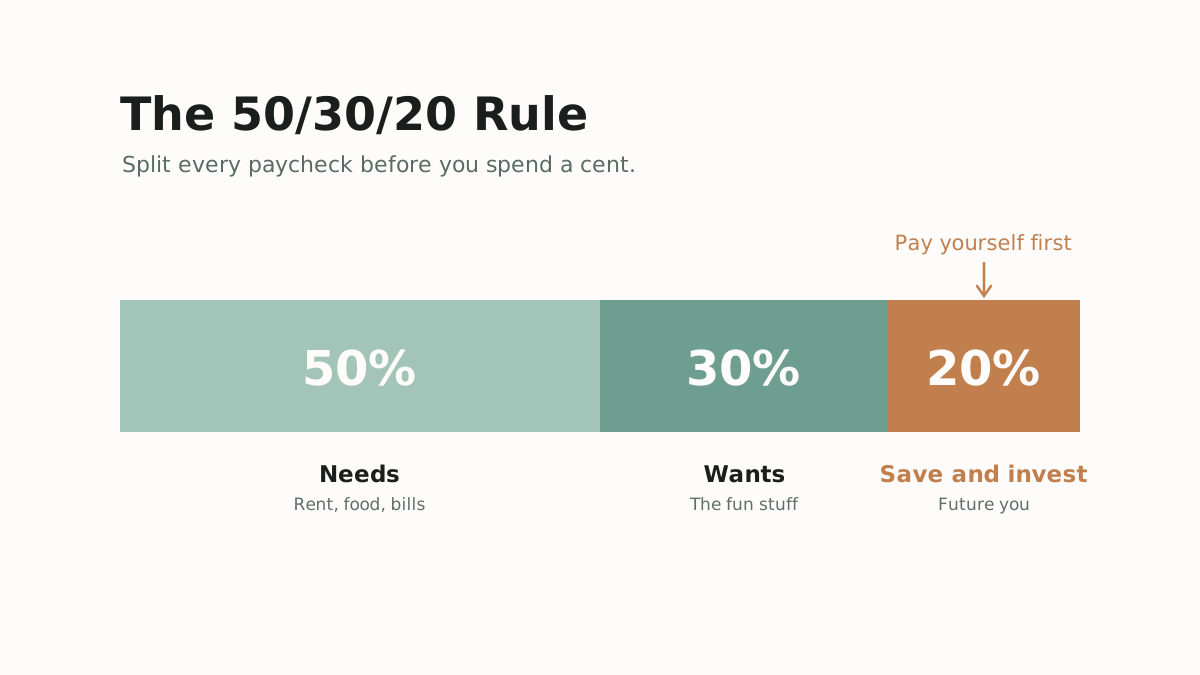
It sounds tedious and it kind of is, for about a month. Use a spreadsheet or a free app, and try the 50/30/20 rule as a starting point: 50% needs, 30% wants, 20% savings.
4. Learn the difference between wants and needs
I learned this one the hard way, after blowing a lot of money on fashion, shoes and convenience.
Did I really need another pair of Yeezys, ripped jeans or another dad hat? It sure felt like it.
Do I still wear them today? Nope.
I’m all for spending on things that make you genuinely happy. That only works if you skip the stuff that doesn’t. If everything is a need, you’ll go broke. That might mean keeping your phone another year, fewer UberEats orders, or one less designer piece. Fulfill your needs and take it easy with your wants.
5. Build an emergency fund
With emergencies, it’s never a matter of if. It’s when. The car breaks down, the phone dies, someone gets sick.
The Federal Reserve asks Americans every year how they’d handle a surprise $400 bill. In its 2025 survey, 37% said they couldn’t cover it with cash or its equivalent. They’d have to borrow, sell something, or not pay at all.
An emergency fund is money in a separate savings account that you only touch when life happens. Aim for three to six months of expenses, closer to six if your income is unpredictable. Start with one month. It changes how a bad week feels.
6. Cut costs where it doesn’t hurt
You can’t always raise your income quickly. You can almost always cut something this week.
Look at the boring stuff first: your phone plan, the streaming services you forgot about, the gym membership you don’t use, buying lunch every day instead of packing it some days.
Even an extra $50 a month is $600 a year. And I guarantee you can find more than $50 if you honestly go through your statements.
7. Stop living paycheck to paycheck
When every dollar is spoken for before it arrives, you can’t save, you can’t invest, and every surprise becomes a crisis.
The way out is simple to say and hard to do: spend less than you earn, every month. It’s tempting to go all out when your first real paycheck lands. Don’t upgrade your whole life just yet. It feels great at first, and then the costs creep up until they eat every raise you get.
8. Find the right career path
I chose the wrong profession. I knew it halfway through my nursing degree and forced myself to finish anyway, thinking, “maybe I’ll like it once I start working.”
The paycheck was nice. The work wasn’t for me, and I felt stuck. Luckily, the skills and experience I’d built helped me find a new job about a year later.
If your career doesn’t feel right, start looking now. Your 20s are the cheapest time to switch: you probably don’t have a mortgage or kids yet, so starting over costs a lot less than it will at 35. It’s never too late, but it’s rarely easier than now.
You’ll work most of your life, whether for yourself or someone else. Ask around, try things, and pick something that means something to you.
9. Build skills that raise your income
Saving will only take you so far. At some point the bigger lever is earning more: a promotion, a side project, a better job, a raise you actually negotiate.
Here’s why it matters so much. Say you save 20% of your income:
- On a $45,000 after-tax salary, that’s $9,000 a year saved and $36,000 to live on.
- Raise that to $70,000 after a few years and you’re saving $14,000 a year, with $56,000 to live on.
That’s $5,000 more saved and $20,000 more to spend, without changing your habits at all. And if you keep living below your means as your income grows, you could save well past 20% without feeling deprived.
Skills that tend to pay:
Hard skills: programming, data analysis, digital marketing, writing and copywriting, project management.
Soft skills: public speaking, communication, negotiation, emotional intelligence, conflict resolution, teamwork, problem-solving.
Pick one or two that interest you and that your next job would actually pay for, and go deep.
10. Start investing early
I used to think people got rich by saving. That’s how I was raised. My parents and the grown-ups around me were terrified of investing because “you’ll lose all your money,” they said.
So I thought, “what’s the point of investing the little money I have, anyway?” Instead I overspent on clothes I didn’t need, eating out when there was food at home, and partying.
I started investing at 23. If I could go back, I’d open a TFSA (or a Roth IRA, if you’re in the US) the day I turned 18. You can start with $25 a month. What matters is consistency and time in the market, and your 20s give you the most time you’ll ever have. I wrote a plain-English guide to how the stock market works if you’re starting from zero.
Keep it simple: a broad, low-fee ETF or a robo-advisor like Wealthsimple does most of the work for you. Watch out for high-fee mutual funds, no matter who recommends them. Set up an automatic monthly deposit and let it run.
11. Avoid high-interest debt
Before you invest, pay off any high-interest debt, especially credit cards. Credit card interest is usually well above anything the market reliably pays, so paying it off is the best guaranteed return you’ll find.
Student loans are a judgment call. Depending on your rate and where you live, it can make sense to pay them down slowly. Personally, I’d still pay them off.
12. Build a good credit score
Your credit score is what lenders look at when you want a mortgage, a car loan or even an apartment. A better score means better rates, and on a mortgage that can mean thousands of dollars.
You build it slowly and you can wreck it fast. Pay every bill on time, every time, and don’t max out your cards.
Where to start this month
Your 20s shape a lot of what comes after. Have fun, keep your social life, try new things. Just don’t let bad money habits set in while you do, because they’re much harder to undo at 35.
Money won’t make you happy. But it can absolutely make you unhappy, and that part is preventable.
Here’s where I’d start, whether you’re 21 or 29:
- Make a budget and look at last month honestly.
- Pay off any high-interest debt.
- Cut two costs you won’t miss.
- Watch for lifestyle creep when your next raise lands.
- Pay every credit card bill on time, in full.
- Automate a small investment on payday.
- Pick one skill that could raise your income, and start.
Do your future self a favour. You’ll thank yourself later, seriously.