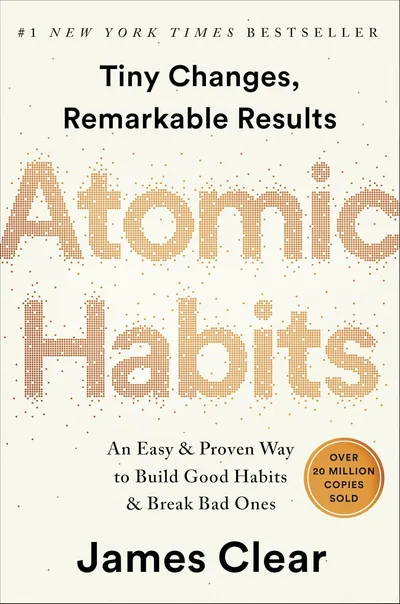
Atomic Habits
Key Takeaway
Stop chasing motivation. Build systems instead. The days you don’t feel like showing up are the days that matter most, because those are the days that separate people who get results from people who just talk about getting results.
The Big Picture
- Your outcomes are a lagging measure of your habits. You don’t get what you want, you get what you repeat
- Identity drives behavior, not the other way around. Decide who you want to be, then prove it with small wins
- Systems beat goals every single time. Goals are about the destination. Systems are about what you actually do on a random Tuesday morning when you’d rather stay in bed
Why This Book Matters
This book is extremely good. I don’t say that lightly. I’ve read enough self-help to know that most of it is recycled advice in a new jacket. Atomic Habits is one of the rare ones that actually delivers on its promise.
Here’s the thing: when I was stuck in my nursing career feeling unfulfilled, I kept looking for the big breakthrough. The one insight that would change everything. The burst of motivation that would finally launch me into a new life. And I’d get those bursts. I’d wake up one Saturday morning fired up, work for four hours straight, feel incredible, and then.. nothing. The energy would fade by Wednesday. The plan would collect dust. The motivation would evaporate like it always does.
That’s the trap. And I fell into it over and over.
What Atomic Habits taught me, and this is the single most important thing I’ve taken from it, is that you cannot build a life on bursts of energy and inspiration, because those are fleeting. The mornings you wake up fired up and crush it? Those feel amazing. They’re also completely unreliable. The mornings you don’t feel like it but show up anyway and do 30 minutes? Those are what actually compound.
Read that again.
The habit runs whether you feel like it or not. That’s the whole point. Systems don’t depend on how you feel. Goals do. And feelings are the worst foundation you can build on.
Core Concepts
The Four Laws of Behavior Change
Clear gives you a dead-simple framework for building any habit:
1. Make it Obvious. Design your environment so the cue for your desired behavior is impossible to miss. I used to keep my phone on my desk and wonder why I couldn’t focus. Now the phone goes in a drawer and books sit on the desk instead. Sounds trivial. Changed everything. When you see the book, you read. When you see the phone, you scroll. Your environment is making decisions for you whether you realize it or not.
2. Make it Attractive. Pair the habit you need to do with something you want to do. Join a culture where your desired behavior is normal. This clicked for me when I noticed how my spending habits shifted based on who I was around. When I started spending time with more entrepreneurial friends, saving and investing stopped feeling like sacrifice, it became the default. The people around you set the standard for what’s normal. Choose those people carefully.
3. Make it Easy. Reduce friction. Scale habits down. Use the Two-Minute Rule, if a habit takes more than two minutes to start, it’s too big. I use this constantly with writing. I get massive fulfillment from writing once I’m in the zone, but I face so much resistance before getting into it. So the rule isn’t “write for an hour.” The rule is “open the document and write one sentence.” That’s it. Two minutes. And almost every single time, one sentence turns into a full session. The hardest part is just starting.
4. Make it Satisfying. Give yourself an immediate reward for long-term habits. Track your streaks. And follow the “never miss twice” rule, if you skip today, you absolutely cannot skip tomorrow. Missing once is an accident. Missing twice is the start of a new habit. This rule alone has saved me from abandoning habits more times than I can count.
Identity-Based Habits
This might be Clear’s most profound insight. Most people set goals like “I want to run a marathon.” Clear says flip it: “I am a person who runs.”
Every action you take is a vote for the type of person you want to become. You don’t need a unanimous vote. You just need a majority. Skip a workout, that’s one vote for being sedentary. Show up the next day, that’s one vote for being active. The votes accumulate, and over time, they form an identity.
When I stopped saying “I’m trying to write more” and started saying “I’m someone who writes daily,” the shift was immediate. I wasn’t forcing myself to do something unnatural. I was being consistent with who I’d decided I was. That distinction sounds small. It’s not.
This connects directly to what Maxwell Maltz describes in Psycho-Cybernetics. Maltz’s entire thesis is that your self-image determines your behavior, you will always act consistently with the person you believe yourself to be. Clear is essentially giving you the practical mechanism to change that self-image, one small vote at a time.
The Plateau of Latent Potential
This is the concept that keeps people going when they want to quit. Habits follow a pattern: long stretches of invisible progress, then sudden breakthroughs that look like overnight success to everyone else.
Clear calls it the Plateau of Latent Potential, the valley between starting a habit and seeing results. Most people quit in this valley because it feels like nothing is happening. But the work isn’t being wasted. It’s being stored.
I lived this with my fitness. Months of consistent training with almost nothing to show for it. No visible changes. Same weights. Same pace. I seriously questioned whether any of it mattered. And then, almost out of nowhere, my strength jumped. My endurance spiked. The changes came in bunches after months of apparent stagnation.
The key is trusting the process during the plateau. That’s where most people bail.
Motion vs. Action
Motion is planning, strategizing, researching, organizing. Action is doing the thing that actually produces a result. Motion feels productive. Action is productive. They are not the same.
I used to spend hours “planning my business”, outlining strategies, researching competitors, building spreadsheets, designing logos. None of that was wrong, but none of it was moving anything forward. I was in motion. I wasn’t taking action. The moment I started actually creating, actually shipping, actually putting work in front of people, that’s when things changed.
Clear puts it perfectly: “The most effective form of learning is practice, not planning.”
Systems Over Goals
If you’re a basketball coach and your goal is to win the championship, does the goal itself help you win? No. Every other coach has the same goal. The difference is the system, the daily practices, the training regimen, the recruiting process, the culture.
Goals are useful for setting direction. Systems are what produce results. And here’s the part nobody talks about: goals create a pass/fail binary. Either you hit the goal or you didn’t. Systems create a daily win. Did you follow the process today? Yes? Then today was a success, regardless of where you are relative to some distant finish line.
This reframe changed how I approach everything. I stopped obsessing over outcomes and started investing in processes. The results follow. They always do.
What I’ve Found Most Useful
Environment design over willpower. Willpower is a depletable resource. Environment design is permanent. Phone in the drawer, books on the desk. Healthy food at eye level, snacks in the back of the pantry. Or better yet, not buying snacks at all. Can’t eat what isn’t there.
The Two-Minute Rule for beating resistance. Every habit that matters to me started as a two-minute version of itself. Two minutes of meditation became 20. One sentence of writing became a full session. The rule removes the intimidation factor. You’re not committing to an hour. You’re committing to starting. And starting is 90% of the battle.
“Never miss twice” as a personal contract. This single rule has been more impactful than any goal I’ve ever set. Bad days happen. Missed workouts happen. The rule doesn’t demand perfection. It demands resilience. Get back on the horse tomorrow. That’s it.
The habit-identity feedback loop. Every time I show up and do the thing, even when I don’t feel like it, especially when I don’t feel like it, I’m casting a vote for the person I want to be. Over weeks and months, those votes add up. And one day you realize you’re not forcing anything anymore. You’re just being who you are.
Memorable Quotes
“You do not rise to the level of your goals. You fall to the level of your systems.”
“Every action you take is a vote for the type of person you wish to become.”
“You should be far more concerned with your current trajectory than with your current results.”
“The most effective form of learning is practice, not planning.”
“You don’t have to be the victim of your environment. You can also be the architect of it.”
Final Thoughts
Let’s be real: this book could be 30% shorter. The core framework, the four laws plus identity-based habits, is where all the value lives. The rest is supporting evidence and examples, which are good but occasionally repetitive. And the famous “1% better every day means you’ll be 37 times better in a year” math? Motivational, but misleading. Growth isn’t that linear. Real habit-building is messier than Clear sometimes lets on. Some habits take months of grinding failure before they click.
But none of that changes the fundamental truth at the center of this book: what you do daily matters infinitely more than what you do occasionally.
Cal Newport’s Deep Work practice is an atomic habit. Newport didn’t build his focus capacity in a single heroic effort, he built it through daily, protected blocks of concentration. The ritual is the habit. Marcus Aurelius journaling every night was an atomic habit before the term existed, daily self-programming through small, consistent inputs. And then there’s Goggins, who represents the opposite end of the spectrum, extreme intensity, brute-force willpower, sheer suffering. Both approaches work. But Clear’s gentle 1% method is sustainable for the long game in a way that Goggins’ approach often isn’t. Different medicine for different people.
Essentialism also pairs well here. McKeown’s “less but better” philosophy means fewer habits, but the ones you choose, you do with absolute consistency. Don’t try to build 12 habits at once. Pick two. Nail them. Then add.
This is the book I recommend more than any other. Not because it’s the most profound thing I’ve ever read. But because it’s the most useful. It meets you where you are and gives you a system that works on the days when you’re inspired and on the days when you’re not.
And those uninspired days? Those are the ones that count.
— filed under programming

David Vo
Writing about mindset, purpose, money, and building with AI, from Montreal. Breaking free from autopilot, one system at a time.
Related book notes
The Laws of Human Nature
You're not as rational as you think. Neither is anyone else. Understanding this changes every interaction you'll ever have.
Meditations
The most powerful man in the world journaling to himself about how to not be an idiot, and somehow it's the most relatable book ever written.