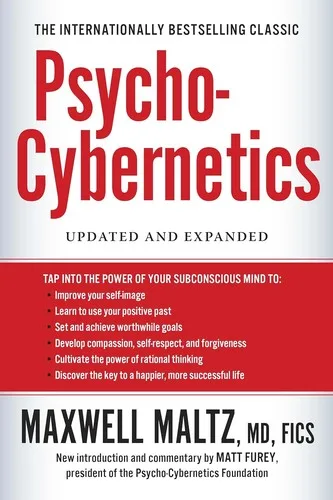
Psycho-Cybernetics
Key Takeaway
You will always perform in a way that’s consistent with the person you believe yourself to be. Not the person you want to be. Not the person you tell others you are. The person you see when no one else is looking. Change that internal picture, and your behavior follows automatically. Keep the old picture, and no amount of willpower, discipline, or strategy will matter, you’ll always snap back.
The Big Picture
- Your self-image is the invisible ceiling on everything you achieve, you cannot consistently outperform it
- Your brain is a goal-seeking servo-mechanism: give it a target (your self-image), and it will steer toward it whether that image is empowering or destructive
- Mental rehearsal works because your nervous system can’t distinguish between a real experience and one vividly imagined, the same neural pathways fire either way
Why This Book Matters
This is one of the most important books I’ve ever read. Full stop.
I don’t say that about many books. I’ve read enough personal development to know that 90% of it is the same five ideas repackaged in different fonts. But Psycho-Cybernetics isn’t recycled advice. It’s the source material. The book that most modern self-help is built on, usually without crediting Maltz at all.
Here’s the thing: Maxwell Maltz was a plastic surgeon in the 1960s. He spent years changing people’s faces, correcting scars, reshaping noses, fixing features that had caused people a lifetime of insecurity. And what he noticed changed the entire direction of his career. Some patients got the surgery, looked in the mirror, and became completely different people. More confident. More outgoing. More alive. But others got the exact same surgery, looked in the same mirror, and still felt ugly. The scar on the outside was gone. The scar on the inside hadn’t moved.
That observation is the entire book. Your face isn’t the problem. Your body isn’t the problem. Your circumstances aren’t the problem. Your self-image is the problem. It’s the operating system running underneath everything, your habits, your confidence, your relationships, your income, your willingness to take risks. Change the OS, and the applications change. Leave the OS untouched, and you’ll keep crashing no matter how many surface-level fixes you apply.
I needed this book when I found it. I was in the middle of a transition, leaving a career path that made sense on paper but didn’t fit the person I was becoming. And the hardest part wasn’t the logistics. It wasn’t the finances or the uncertainty or the judgment from people around me. The hardest part was that I still saw myself as the person on the old path. My self-image was “nursing student.” Safe choice. Practical career. Follow the plan.
And as long as that was the picture I held of myself, every action I took to build something new felt like fighting gravity. I’d make progress and then pull back. Start a project and abandon it. Get momentum and then find a reason to stop. It wasn’t laziness. It wasn’t lack of motivation. It was my servo-mechanism doing exactly what Maltz describes, steering me back toward the image I held of myself, which was someone who doesn’t build businesses or create content or take wild career bets.
Read that again. Because if you’ve ever wondered why you self-sabotage, why you get close to a breakthrough and then mysteriously retreat, this is the answer. Your self-image has a thermostat setting. Go above it, and the system pulls you back down. Go below it, and it pushes you back up. Either way, you always return to the picture.
Psycho-Cybernetics gave me the framework to reprogram that picture. Not through affirmations. Not through gritting my teeth harder. Through understanding how the mechanism actually works, and then deliberately feeding it a new target.
Core Concepts
The Self-Image: Your Internal Blueprint
Maltz’s central thesis is deceptively simple: you act, feel, and perform in accordance with what you imagine to be true about yourself. Not what is true. What you imagine to be true.
If you imagine yourself as someone who’s bad with money, you’ll find ways to be bad with money, even when you know the right moves. If you imagine yourself as someone who can’t speak in public, your hands will shake and your voice will crack because your self-image demands it. The behavior isn’t the root cause. The image is.
This is what I mean when I talk about your mental operating system. The self-image is the deepest layer of code running in the background. Your habits, your reactions, your decisions, those are all applications running on top of it. You can update the apps all you want, but if the OS is still running “I’m not the kind of person who succeeds at this,” the apps will keep crashing.
James Clear built his entire identity-based habits framework in Atomic Habits on this exact foundation. “Every action is a vote for the type of person you want to become”, that’s Maltz’s self-image theory in modern packaging. Clear gives you the mechanism (small, repeated actions). Maltz gives you the why behind it, those actions work because they gradually update the internal picture.
The Servo-Mechanism: Your Brain as a Guided Missile
Your brain works like a self-correcting navigation system. Give it a target, and it will adjust, recalculate, and course-correct until it reaches that target. Maltz borrowed the term from cybernetics, the study of goal-seeking machines, and applied it to human psychology.
Here’s where it gets interesting. The servo-mechanism doesn’t care whether the target is good for you. It doesn’t judge. It just steers. If your self-image says “I always choke under pressure,” your nervous system will find a way to make that happen. Sweaty palms. Racing thoughts. Blanking on words you’ve rehearsed a hundred times. It’s not weakness. It’s precision engineering toward the wrong target.
But flip it, give the mechanism a new target, a self-image that says “I perform well when it counts”, and the same system starts working for you. It finds ways to stay calm. It surfaces the right words. It manufactures confidence from the same raw materials that were producing anxiety five minutes ago.
This is what self-sabotage actually is. It’s not you failing. It’s your servo-mechanism succeeding, at hitting a target you didn’t consciously choose. You achieve something beyond your self-image, and the system says “that’s not us” and pulls you back to baseline. Understanding this changed how I interpreted every pattern of retreat in my own life.
Theater of the Mind: Mental Rehearsal
Maltz’s most practical tool. Your nervous system cannot distinguish between a vividly imagined experience and a real one. The same neural pathways fire. The same emotional responses activate. The same muscle patterns engage.
This means you can practice success before it happens. Not daydream about it, that’s different. Maltz is talking about deliberate, detailed mental rehearsal. Seeing yourself in the situation. Feeling the emotions. Walking through the steps. Your brain processes it as experience, and experience builds the self-image.
Athletes have used this for decades. Surgeons mentally rehearse complex procedures. Musicians play pieces in their heads before performances. The principle is the same every time: the nervous system responds to mental images as if they were real. So if you repeatedly imagine yourself performing at a level above your current self-image, you’re writing new code. You’re giving the servo-mechanism a new target to aim for.
I used this, maybe not as formally as Maltz prescribes, when I was making my career shift. I spent time imagining what my days would look like if I built the thing I wanted to build. Not fantasizing about outcomes. Imagining the process. Sitting down to write. Creating something useful. Putting it in front of people. The more vividly I pictured that version of myself doing those things, the more natural it felt when I actually started doing them. The self-image shifted before the circumstances did.
Automatic Success Mechanism vs. Automatic Failure Mechanism
Maltz identifies two modes your internal system can operate in. The Automatic Success Mechanism activates when your self-image is aligned with your goals. You feel creative, spontaneous, resilient. Solutions come to you. Opportunities appear. You’re in flow.
The Automatic Failure Mechanism kicks in when your self-image is threatened or when you’re operating outside the picture you hold of yourself. Suddenly you’re tense, rigid, overthinking everything. You fixate on problems. You find reasons things won’t work. You feel blocked.
Here’s the critical piece: the failure mechanism isn’t activated by hard circumstances, it’s activated by trying to be someone your self-image says you’re not. Two people can face the exact same challenge. One moves through it with creative energy. The other locks up. The difference isn’t talent or toughness. It’s self-image alignment.
Carol Dweck’s growth mindset is essentially Maltz’s success mechanism described in academic language. A growth mindset is a self-image that includes the possibility of change and improvement. A fixed mindset is a self-image that’s locked, and when you’re locked, the failure mechanism runs the show.
Relaxation as Performance
This is counterintuitive and I think it’s one of Maltz’s most underrated insights. Trying too hard creates internal tension, and tension blocks the servo-mechanism from doing its job. The more you strain to perform, the worse you perform. The more you force creativity, the less creative you become.
Maltz’s prescription: relax. Not “don’t care.” Not “be lazy.” Relax the internal tension that comes from over-effort. Trust the mechanism. You’ve already programmed the target through mental rehearsal and self-image work. Now get out of the way and let the system operate.
This runs directly counter to the Goggins-style “just push harder” approach. And honestly? Both are true in different contexts. There are moments where you need to override the governor and push through pain. But there are also moments, maybe more of them, where the obstacle isn’t insufficient effort. It’s too much effort creating tension that blocks the very performance you’re chasing.
What I’ve Found Most Useful
The self-image as a diagnostic tool. When I notice myself retreating from something I know I should be doing, I don’t ask “why am I being lazy?” anymore. I ask “what’s my self-image saying?” That question surfaces the real issue almost every time. Usually the answer is some version of “you’re not the type of person who does this.” And once I can see that belief clearly, I can start dismantling it.
Mental rehearsal before high-stakes situations. Before a difficult conversation, before launching something new, before any moment where I feel the failure mechanism starting to spin up. I run the theater of the mind. I picture myself in the situation, handling it the way the updated version of me would handle it. Five minutes of that is worth more than an hour of anxious preparation.
The servo-mechanism reframe for self-sabotage. Understanding that pulling back from success isn’t weakness but a system functioning as designed, that reframe was everything. It took the shame out of self-sabotage and replaced it with a mechanical problem I could actually solve. The system isn’t broken. The target is wrong. Update the target.
Relaxation as a strategy, not a reward. I used to think relaxation was what you earned after performing well. Maltz flipped that for me. Relaxation is what enables the performance in the first place. The days I create my best work are never the days I’m grinding my teeth trying to produce. They’re the days I sit down, trust the process, and let it flow.
Memorable Quotes
“The self-image is the key to human personality and human behavior. Change the self-image and you change the personality and the behavior.”
“You act, and feel, not according to what things are really like, but according to the image your mind holds of what they are like. You have certain mental images of yourself, your world, and the people around you, and you behave as though these images were the truth, the reality, rather than the things they represent.”
“The nervous system cannot tell the difference between an actual experience and an experience imagined vividly and in detail.”
“Realizing that our actions, feelings, and behavior are the result of our own images and beliefs gives us the lever that psychology has always needed for changing personality.”
Final Thoughts
Let’s be real: this book was published in 1960 and you can feel every year of it. The language is dated. The case studies involve mid-century housewives and traveling salesmen. Some of the “scientific evidence” for visualization wouldn’t survive a modern peer review. And it’s probably 30% longer than it needs to be. Maltz makes his core point beautifully, then proceeds to make it again and again with different patient stories until you want to grab the book by its shoulders and say “I got it.”
But here’s the thing, and I genuinely mean this, none of that changes the fact that the central insight is as true now as it was in 1960. Maybe more true, because the noise is louder now. You have more inputs telling you who you’re supposed to be. More feeds comparing your behind-the-scenes to everyone else’s highlight reel. More voices programming your self-image without your permission.
What struck me most is how many of the books I love are essentially building on Maltz without saying so. Clear’s identity-based habits in Atomic Habits, that’s Maltz. Dweck’s growth mindset in Mindset, that’s Maltz with research data. Adler’s “lifestyle” concept in The Courage to Be Disliked, that’s Maltz’s self-image by a different name. Even Goggins’ accountability mirror in Can’t Hurt Me is Maltz’s confrontation with the self-image, just dialed up to a hundred. And Frankl’s “choose your response” in Man’s Search for Meaning is really “choose your self-image about what this suffering means.”
Maltz was the headwaters. Everyone else is downstream.
This book reshaped how I think about change. Not as something you force through discipline. Not as something that happens in a dramatic moment of transformation. But as something that starts in the quiet space between your ears, with the picture you hold of yourself when nobody’s watching. Update that picture, and the servo-mechanism handles the rest. It’s not magic. It’s engineering.
And if you’ve been doing all the “right things”, reading the books, building the habits, setting the goals, and still feeling like you’re running on a treadmill, this might be the missing piece. It’s not about doing more. It’s about being different, at the level of identity. The habits follow. The results follow. But the self-image has to move first.
It moved first for me. And everything else followed.
— filed under programming

David Vo
Writing about mindset, purpose, money, and building with AI, from Montreal. Breaking free from autopilot, one system at a time.
Related book notes
The Laws of Human Nature
You're not as rational as you think. Neither is anyone else. Understanding this changes every interaction you'll ever have.
Meditations
The most powerful man in the world journaling to himself about how to not be an idiot, and somehow it's the most relatable book ever written.