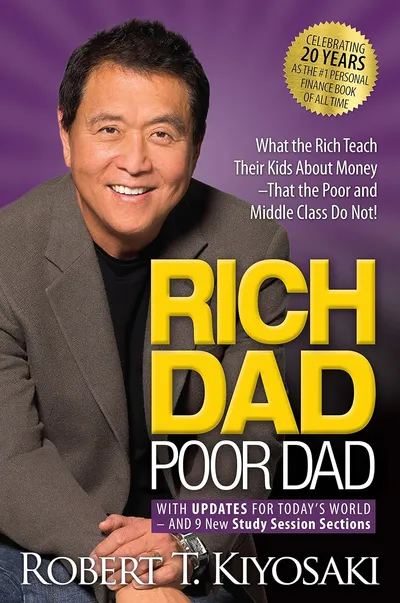
Rich Dad Poor Dad
Key Takeaway
The way you think about money matters more than how much you make. Rich Dad Poor Dad didn’t teach me how to invest. It taught me that my entire financial operating system needed an upgrade, that the beliefs I grew up with about money were holding me back more than my bank balance ever did.
The Big Picture
- The rich don’t work for money, they make money work for them
- An asset puts money in your pocket. A liability takes it out. Most people confuse the two.
- Financial literacy isn’t taught in schools, which means you’re running on whatever your parents installed
Why This Book Matters For Your Day-to-Day Life
I need to be honest with you about this one.
Rich Dad Poor Dad was one of the first personal finance books I ever picked up. And it genuinely rewired something in my brain. But looking back now, after reading books like The Psychology of Money and I Will Teach You To Be Rich, I can see both its power and its cracks. A lot of cracks.
Here’s the thing: I grew up around people who worked hard, earned decent money, and spent it. That was the cycle. Paycheque comes in, paycheque goes out. Nobody talked about assets. Nobody talked about making money work for you. The idea that you could build something that generates income while you sleep, that wasn’t even on the radar.
This book put it on the radar. The mindset shift happened early, within the first few chapters. The assets vs. liabilities reframe, the cashflow quadrant, the idea that your financial education is your responsibility. That hit. Hard.
But then the book keeps going. And going. And honestly? It could’ve been half the length. The core ideas land in the first third, and the rest feels like Kiyosaki retelling the same stories with slightly different wrappers. By the end, I was skimming.
I remember reading his description of his “rich dad” vs his “poor dad” and thinking about my own parents. My mom and dad were classic “poor dad” thinkers, not because they were bad with money, but because nobody ever showed them another way. They worked incredibly hard their entire lives. They saved when they could. But the idea of buying assets that generate cashflow? That was a foreign language.
Read that again. Not bad with money. Just never exposed to a different way of thinking about it.
That distinction matters. And it’s what made me want to help them retire someday, not out of pity, but out of understanding that the game was rigged from the start.
Now here’s where I need to add some nuance. The more I’ve learned about Kiyosaki, the less I trust the messenger, even if some of the message still holds up. The “Rich Dad” character? Researchers have never been able to fully verify he existed as described. Kiyosaki eventually admitted the character was based on a Hawaiian businessman named Richard Kimi, but the book was marketed as straight autobiography. The whole thing reads more like a parable dressed up as a memoir.
And then there’s Kiyosaki’s actual track record. His company Rich Global LLC filed for bankruptcy in 2012 over a $24 million judgment. He’s been predicting catastrophic market crashes since 2011, meanwhile the S&P 500 has tripled. His seminars use aggressive upselling tactics, pushing attendees to raise credit card limits to pay for $12,000-$45,000 courses. CBC Marketplace investigated and found fabricated real estate claims from his seminar presenters.
Let’s be real: Kiyosaki makes his money selling you on the idea of wealth, not from the investment strategies he teaches. That’s worth knowing.
So yeah. This book opened a door for me. The ideas are genuinely useful. But don’t buy too much into everything Kiyosaki tries to sell you, because selling is what he does best.
Core Concepts
Assets vs. Liabilities. The Reframe That Sticks
This is the idea that made this book famous, and honestly, it still holds up.
Kiyosaki’s definition is brutally simple: an asset puts money in your pocket. A liability takes money out. That’s it. By this definition, your house, the one everyone tells you is your biggest asset, is actually a liability. It costs you money every single month.
Now, is this technically oversimplified? Yes. A house can appreciate. There’s nuance here. But the mental model is powerful because it forces you to ask a question most people never ask: “Is this thing I’m buying going to make me money or cost me money?”
I started looking at every financial decision through this lens. And it changed my behaviour more than any budgeting spreadsheet ever did.
The Cashflow Quadrant
Kiyosaki breaks down how people earn money into four categories:
- E. Employee (trading time for a salary)
- S. Self-employed (you own a job, not a business)
- B. Business owner (systems and people work for you)
- I. Investor (your money works for you)
Most people live their entire lives in the E quadrant. Some brave souls move to S. Very few make it to B or I.
The insight isn’t that being an employee is bad. It’s that only being an employee, with no assets generating income on the side, leaves you completely dependent on your ability to trade time for money. And time runs out.
This connected to something I was already feeling but couldn’t articulate. I was watching people in my life work harder and harder but never actually get ahead. The quadrant framework gave me language for why.
Financial Literacy. The Missing Education
Here’s what bothered me most: Kiyosaki argues that schools teach you to be a good employee but never teach you how money actually works. No lessons on taxes. No lessons on investing. No lessons on the difference between an income statement and a balance sheet.
Let’s be real: he’s right about this one.
I went through the entire education system, including nursing school, and never once had a class on personal finance. Everything I know about money, I taught myself. Through books, through FIRE communities, through making mistakes and slowly getting smarter.
The fact that financial literacy isn’t standard curriculum is genuinely one of the biggest failures of modern education. Whatever you think of Kiyosaki, he nailed this.
Making Money Work For You
The central philosophy of the book boils down to this: don’t work for money, make money work for you.
In practice, this means building or acquiring assets that generate income without your direct labour. Real estate that produces rental income. Businesses that run without you. Investments that compound over time.
It’s a compelling vision. But, and this is important, Kiyosaki is much better at selling the idea than explaining the execution. He talks a lot about buying real estate and starting businesses but glosses over the risks, the capital requirements, and the very real possibility of failure.
This is where I started outgrowing the book.
What I’ve Found Most Useful
The mindset shift itself. Before this book, I thought wealth was about earning a high salary. After it, I understood that wealth is about what you keep and what you build. That single reframe was worth everything.
The “pay yourself first” principle. Kiyosaki hammers this: before you pay your bills, set money aside for investments. It sounds irresponsible until you realize it forces you to find ways to cover your expenses and build assets. I combined this with Ramit Sethi’s automation system from I Will Teach You To Be Rich and it became effortless.
Permission to think bigger. Growing up, investing felt like something “other people” did, rich people, finance people, not people like me. This book gave me permission to see myself as someone who could own assets and build wealth. That psychological permission slip was massive.
The vocabulary. Assets, liabilities, cashflow, passive income. I didn’t have these words before. Having the language to think about money differently was the first step toward acting differently.
Memorable Quotes
“The poor and the middle class work for money. The rich have money work for them.”
“It’s not how much money you make. It’s how much money you keep.”
“In the real world, the smartest people are people who make mistakes and learn. In school, the smartest people don’t make mistakes.”
“The single most powerful asset we all have is our mind. If it is trained well, it can create enormous wealth.”
Final Thoughts
I’ll give it to you straight.
Rich Dad Poor Dad is a gateway book. The mindset shift in the first few chapters, assets vs. liabilities, the cashflow quadrant, owning your financial education, is genuinely powerful. It cracked open a door in my thinking that I didn’t know was closed.
But the book is longer than it needs to be, the advice gets vague fast, and the more you learn about Kiyosaki himself, the harder it is to take at face value. The “Rich Dad” story is almost certainly embellished. The seminars are a cash grab. And his actual financial predictions have been wrong more than they’ve been right.
Here’s what I’d tell you: read the first half, absorb the mindset shift, and then put it down. You’ve gotten what you came for. The rest is repetition.
And honestly? If you only want to read one personal finance book, skip this one entirely and pick up The Simple Path to Wealth by JL Collins. It’s everything you need, invest in one index fund, avoid debt, let time compound, without the motivational-speaker energy or the upsell. Stop trying to read every finance book that personal finance gurus try to sell you. One good book, applied consistently, beats ten books gathering dust.
If you want the behaviour science on top of that, read Morgan Housel’s Psychology of Money. If you want the system, read Ramit Sethi’s I Will Teach You To Be Rich.
Kiyosaki gave millions of people, including me, permission to think differently about money. I respect that. But permission is all he gave. The actual instruction manual? You’ll find it elsewhere.
— filed under pockets

David Vo
Writing about mindset, purpose, money, and building with AI, from Montreal. Breaking free from autopilot, one system at a time.