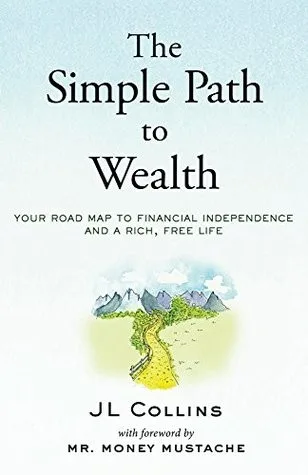
The Simple Path to Wealth
Key Takeaway
Investing doesn’t have to be complicated. Buy one total stock market index fund, keep your expenses low, avoid debt like it’s on fire, and let time do what time does. That’s it. The entire book in four moves.
The Big Picture
- One index fund, VTSAX or its ETF equivalent VTI, beats the vast majority of professional money managers over any meaningful time horizon
- Debt is a financial emergency, not a normal part of life
- “F-you money” isn’t about being rich, it’s about having enough to never be trapped
- The stock market will crash. It will also recover. Every single time. Your only job is to not panic.
Why This Book Matters For Your Day-to-Day Life
I need to tell you something about my relationship with this book.
There was a period, a solid couple of years, where I was deep in the FIRE community. Financial Independence, Retire Early. Subreddits, blogs, spreadsheets, calculators projecting my “FIRE number” down to the month. And in that world, JL Collins was gospel.
His blog, jlcollinsnh.com, was the first thing people recommended to newcomers. “Just read the stock series,” they’d say. And when he turned that series into a book, it became the unofficial bible of the entire movement.
Here’s the thing: the book is literally a letter from a father to his daughter. Collins wrote it because his daughter wasn’t interested in finance, and he wanted to make sure she’d be okay no matter what. That framing changes everything. It’s not a finance bro flexing. It’s a dad who genuinely wants to protect his kid.
And that warmth is what makes it work. Complex financial concepts, expense ratios, asset allocation, the mechanics of index funds, become accessible because they’re explained with love, not jargon.
I read this at a time when I was trying to figure out my own financial path. Growing up, nobody in my family talked about investing. My parents worked incredibly hard, saved when they could, but the stock market felt like a casino, something for rich people to play with. Collins gave me the confidence to actually start. Not because he made me feel smart, but because he made it feel simple.
And simple was exactly what I needed.
Core Concepts
F-You Money
This is Collins’ term for financial freedom, and I love how blunt it is.
F-you money is the amount of money that lets you say no. No to the job that’s crushing your soul. No to the boss who treats you like furniture. No to the obligations that exist only because you can’t afford to walk away from them.
It’s not about retiring at 30. It’s not about yachts. It’s about options.
Think about it. How many decisions in your life are dictated by the fact that you need the next paycheque? F-you money removes that pressure. And when the pressure is gone, you start making decisions based on what you actually want, not what you’re financially forced into.
This concept alone made the book worth it for me. It reframed the entire purpose of saving. I wasn’t saving to hoard. I was saving to be free.
Index Funds Beat Everything
This is Collins’ most powerful argument, and the data backs him up completely.
Over any 20-year period in stock market history, a simple total stock market index fund has outperformed the majority of actively managed funds. Not some of them. Most of them. The people getting paid millions to pick stocks can’t consistently beat the market they’re trying to beat.
Collins’ answer? Stop trying to beat the market. Be the market. Buy VTSAX (Vanguard Total Stock Market Index Fund) or its ETF equivalent VTI, and you own a tiny piece of every publicly traded company in America. You get the entire market’s return for basically zero cost.
For my Canadian readers, and I’m writing this from Montreal, the equivalent play is something like VEQT or XEQT, a globally diversified all-equity ETF, inside your TFSA. The TFSA is our version of the Roth IRA. Everything grows tax-free. That’s the closest thing to a financial cheat code we’ve got.
The simplicity is the point. You don’t need to read financial news. You don’t need to pick stocks. You don’t need a financial advisor taking 1-2% of your portfolio every year to underperform an index fund you could buy yourself. One fund. Automatic contributions. Done.
Debt is an Emergency
Collins doesn’t treat debt the way most personal finance books do, as something to “manage” or “optimize.” He treats it like your hair is on fire.
If you have high-interest debt, that’s a financial emergency. Not an inconvenience. Not a thing you’ll get around to. An emergency. You should be throwing every available dollar at it with the intensity of someone trying to escape a burning building.
The math is straightforward. If you’re paying 20% interest on credit card debt while earning 10% in the stock market, you’re losing ground every single day. Pay off the debt first. Then invest.
This felt extreme to me the first time I read it. Now it feels obvious.
The Stock Market Always Recovers
This is the concept that keeps people in the game when everything looks like it’s falling apart.
Collins walks through every major market crash, 1929, 1987, 2000, 2008, and shows the same pattern every time. Crash. Panic. Recovery. New highs. Crash. Panic. Recovery. New highs. Over and over and over.
The people who lose money in the stock market aren’t the ones who stay invested through crashes. They’re the ones who sell during crashes. They lock in their losses and miss the recovery.
Your job during a market downturn is simple: do nothing. Keep investing. Buy more shares at lower prices. The market will recover. It always has. And the people who held on, or better yet, kept buying, came out ahead every single time.
Read that again. Every. Single. Time.
Simplicity Wins
The financial industry survives by making money feel complicated. Complexity justifies fees. Complexity justifies advisors. Complexity keeps you dependent.
Collins strips all of that away. One fund. Low costs. Stay the course. That’s the entire strategy.
And here’s what the industry doesn’t want you to know: it works better than what they’re selling you. The simple, boring, one-index-fund approach outperforms the vast majority of sophisticated, expensive, actively managed strategies.
Simplicity isn’t a compromise. It’s the edge.
What I’ve Found Most Useful
The confidence to actually invest. Before Collins, investing felt like I needed a finance degree to not get destroyed. After Collins, I understood that the simplest approach was also the best one. I started investing consistently, and I haven’t stopped.
The “don’t panic” framework. I’ve been through a couple of market dips since I started investing. Each time, Collins’ voice is in my head: “The market always recovers. Don’t sell. Keep buying.” That framework has probably saved me thousands in panic-selling losses I never realized.
The debt mindset shift. I used to think of debt as just.. normal. Student loans, car payments, whatever, that’s just how life works, right? Collins made me see debt as actively hostile to my financial freedom. It changed how aggressively I attacked it.
The TFSA clarity. Collins writes for an American audience, so I had to translate, but understanding the power of tax-advantaged accounts (Roth IRA for Americans, TFSA for Canadians) was a game-changer. Maxing out your TFSA with a broad index fund is genuinely one of the smartest financial moves you can make in Canada.
Memorable Quotes
“The beauty of VTSAX is that you are buying a tiny piece of virtually every publicly traded company in the United States. You own the entire market.”
“Stop thinking about what your investments are doing this week, this month, this year. Start thinking about what they’ll be doing in 10, 20, 30 years.”
“The stock market is the most powerful wealth-building tool ever created. But only if you can resist the urge to tinker with it.”
Final Thoughts
If someone told me they wanted to build wealth and asked which one book to read, this is the one I’d hand them.
Not Rich Dad Poor Dad. Not the latest finance guru’s bestseller. This one.
Here’s why: the personal finance world has a problem. There are hundreds of books, thousands of podcasts, and an entire industry of people trying to sell you their “system.” Most of them are saying the same thing in different packaging. And the noise makes you think investing is harder than it is, that you need more information, more tools, more courses before you can start.
Collins cuts through all of it. One index fund. Avoid debt. Don’t panic. Let time do its thing. That’s it. You could read this book in a weekend, set up your accounts on Monday, and never need another finance book again.
I mean that literally. Stop trying to read every personal finance book that gurus try to sell you. One good book, applied consistently, beats ten books gathering dust on your shelf.
Now. I have a more complicated relationship with this book than I used to. When I first read it, I was all-in on the FIRE approach. Accumulate. Minimize expenses. Max out every account. Hit that number and never look back. Collins was the foundation for all of it.
But I’ve evolved since then.
Reading Bill Perkins’ Die With Zero put a crack in the pure accumulation mindset. The idea that you could over-save, that you could die with a pile of money and a pile of regret, forced me to reconsider. Collins says accumulate and invest. Perkins says spend and experience. I sit somewhere in the middle now. Build the foundation Collins describes, but don’t forget to actually live while you’re building it.
If you want to go deeper after this one, Morgan Housel’s Psychology of Money covers the behavioural side, why smart people make dumb money decisions. And Ramit Sethi’s I Will Teach You To Be Rich gives you the automation system to make it effortless. But those are bonuses. Collins is the foundation.
One book. One fund. One lifetime of compounding.
That’s the simple path.
— filed under pockets

David Vo
Writing about mindset, purpose, money, and building with AI, from Montreal. Breaking free from autopilot, one system at a time.