I Will Teach You To Be Rich
Key Takeaway
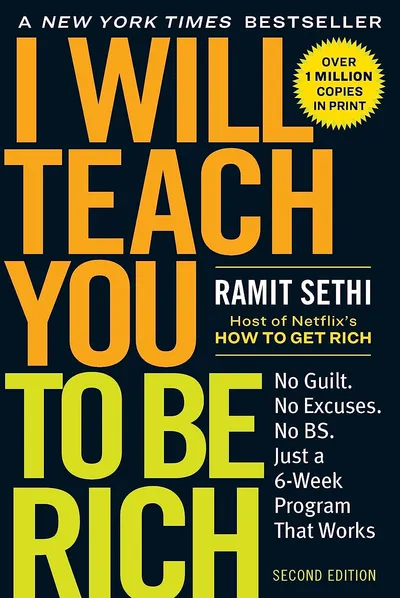
Stop cutting lattes and start automating. Build a system that handles your money so you can spend freely on what you actually love, without guilt, without spreadsheets, without thinking about it.
The Big Picture
- The “big wins” approach beats penny-pinching every time, negotiate your salary once and it compounds for decades
- Automate your finances so the right amount flows to savings, investments, and bills without you lifting a finger
- Conscious spending means spending extravagantly on things you love while cutting ruthlessly on things you don’t
Why This Book Matters For Your Day-to-Day Life
I used to be the guy who tracked every single purchase in a spreadsheet. Every coffee. Every parking meter. I’d feel guilty about a $15 lunch while ignoring the fact that I hadn’t negotiated my salary in two years.
Ramit Sethi flipped that on its head for me.
The core argument is simple: stop worrying about the small stuff and focus on the 5-10 big financial decisions that actually move the needle. Your salary negotiation, your investment allocation, your automated savings rate, these matter infinitely more than whether you bought a latte this morning.
This hit me at a time when I was deep in personal finance communities where people would agonize over switching banks to save 0.1% on interest while their career earnings sat untouched. The math doesn’t lie, a single salary negotiation can be worth more than a decade of coupon-clipping.
What I respect most about Sethi’s approach is that it’s not about deprivation. It’s about intentionality. Spend extravagantly on the things that bring you joy and cut mercilessly on the things that don’t. That’s a philosophy I can actually live with.
Core Concepts
Conscious Spending Plan
This is Sethi’s alternative to traditional budgeting, and it changed how I think about money allocation.
Instead of tracking every dollar reactively, you decide upfront where your money goes:
- Fixed costs (50-60%): Rent, utilities, debt, subscriptions, the non-negotiables
- Investments (10%): Long-term wealth building, retirement accounts
- Savings (5-10%): Emergency fund, vacation fund, short-term goals
- Guilt-free spending (20-35%): Whatever you want. No justification needed.
That last category is the game-changer. Most budgets make you feel bad about spending. This one gives you explicit permission to spend on what you love, as long as the other buckets are handled first.
I combined this with my “fun fund” approach from reading Die With Zero. The conscious spending plan handles the structure; the fun fund handles the mindset. Together, they removed the guilt I used to carry around every purchase.
The Big Wins Philosophy
Sethi argues that personal finance experts have it backwards. They focus on tactics (cut this, save that) instead of strategy (earn more, automate, negotiate).
The big wins:
- Automate your finances, set up your accounts so money flows to the right places on payday, before you can touch it
- Negotiate your salary, even a $5,000 raise compounds to over $150,000 across your career
- Start investing early, time in the market beats timing the market, every single time
- Optimize your credit, a good credit score saves you tens of thousands on mortgages and loans
I used to spend hours optimizing small expenses. Now I spend that energy on one big negotiation or one strategic investment decision per quarter. The ROI is incomparable.
Automation: The Invisible System
This is the part that actually changed my behaviour, not just my thinking.
Sethi’s system works like this: your paycheck hits your checking account, and automatic transfers immediately split it across savings, investments, and bill payments. What’s left is yours to spend freely.
The beauty is that you make the decision once and then it runs forever. You don’t rely on willpower. You don’t need to “remember” to save. It just happens.
I set this up years ago and it’s the single best financial decision I’ve made. My savings rate went up, my investment contributions became consistent, and I actually spend less time thinking about money now than when I was obsessively tracking every dollar.
Negotiation is a Skill, Not a Talent
Most people never negotiate because they’re afraid of hearing “no.” Sethi argues this is the most expensive fear you’ll ever have.
He provides scripts for negotiating salary, bills, even bank fees. The framework is simple:
- Research your market value
- Prepare your case with specific contributions
- Practice the conversation
- Ask with confidence and a specific number
I’ve used versions of this approach at work and it’s worked more often than I expected. The worst that happens is they say no. The best that happens is a compounding raise for the rest of your career.
What I’ve Found Most Useful
The automation setup: I literally followed Sethi’s flow chart for setting up accounts and automatic transfers. It took about two hours and I haven’t thought about it since. My finances run themselves.
“Spend extravagantly on the things you love”: This permission slip was worth the price of the book. I used to feel guilty about spending on experiences and meals with friends. Now I budget for it explicitly and enjoy it fully. It connects directly to the Memory Dividends concept, money spent on experiences you love isn’t wasted, it’s invested.
The 85% solution: Sethi says getting started with an 85% solution beats waiting for the perfect 100% plan. I’ve applied this beyond finances, to my business, my writing, my fitness. Just start. Optimize later.
Negotiating recurring bills: I called my internet provider and my insurance company using Sethi’s scripts. Saved about $600 a year in under 30 minutes. That’s a better hourly rate than most side hustles.
Memorable Quotes
“There’s a limit to how much you can cut, but no limit to how much you can earn.”
“The single most important thing you can do to be rich is to start early.”
“I’d rather spend $500 on something I love without worrying about it than spend $5 on something I don’t care about and feel guilty.”
“Rich people don’t just think about investing, they actually invest. Regularly. Automatically.”
Final Thoughts
Here’s what separates this book from most personal finance advice: it assumes you’re smart enough to handle your own money but lazy enough to need a system that does it for you.
That’s not an insult. That’s reality.
The people who build wealth aren’t the ones with the most discipline. They’re the ones with the best systems. Set it up once, let it run, and focus your energy on earning more and living well.
If Die With Zero taught me why to spend on experiences, this book taught me how to afford them without sacrificing my future.
— filed under pockets

David Vo
Writing about mindset, purpose, money, and building with AI, from Montreal. Breaking free from autopilot, one system at a time.