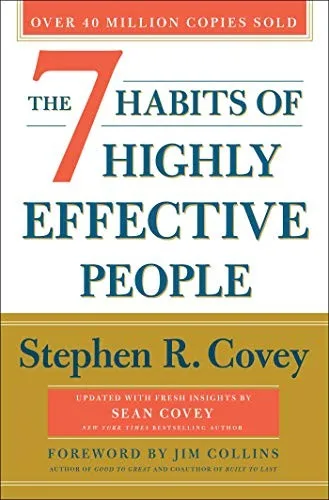
The 7 Habits of Highly Effective People
Key Takeaway
Most self-help books give you tactics. Covey gives you a philosophy. The 7 Habits isn’t about doing more or optimizing your schedule. It’s about becoming the kind of person who doesn’t need hacks, because your character, your principles, and your priorities are already aligned. Build from the inside out, and the results take care of themselves.
The Big Picture
- Effectiveness isn’t a technique. It’s a function of character, and character is built through principles, not personality tricks
- You grow through three stages: dependence, independence, interdependence. Most people stop at independence and think they’ve arrived
- The urgent and the important are almost never the same thing, and most people spend their entire lives confusing the two
Why This Book Matters
I’ll be honest. I put off reading this book for years. The title sounds like something your corporate HR department would assign. The cover screams “business seminar from 1993.” And at 381 pages, it’s not exactly a beach read.
But here’s the thing: there’s a reason 40 million copies exist in the world.
I picked it up during a stretch where I’d read dozens of personal development books and started noticing something. The best ideas kept pointing back to the same source. Essentialism’s “less but better”? That’s Habit 3. Deep Work’s focus on the important over the urgent? That’s Covey’s time management matrix. The Subtle Art’s “choose your values”? That’s Habit 2 with more profanity.
Covey wrote the playbook. Everyone else wrote the footnotes.
What makes this book different from most self-help is the opening argument, the one that quietly might be more important than the seven habits themselves. Covey draws a line between what he calls the character ethic and the personality ethic. The character ethic says: become a person of integrity, patience, courage, and discipline, and effectiveness follows naturally. The personality ethic says: learn the right techniques, communication tricks, and image management strategies, and you’ll get what you want.
Read that again.
Most modern self-help lives in the personality ethic. How to influence people. How to present yourself. How to “hack” your way to results. Covey argues that without character underneath, those techniques are manipulation at worst and fragile at best. You might get short-term wins. But you won’t build a life you actually respect.
That distinction reframed how I think about everything I read.
Core Concepts
The Maturity Continuum
Before the habits, Covey lays out a progression that most people miss.
Dependence: you need others to get what you want. Someone else sets your schedule, your income, your identity. Independence: you can take care of yourself. You think for yourself, earn for yourself, stand on your own. Interdependence: you combine your strengths with others to achieve things none of you could alone.
Here’s the part nobody talks about: most self-help stops at independence. “Be self-reliant. Don’t need anyone. Grind alone.” And yeah, that’s a step up from dependence. But Covey argues it’s not the destination. The highest level of effectiveness is interdependence, working with others in a way that multiplies what you’re each capable of individually.
Habits 1-3 move you from dependence to independence. Habits 4-6 move you from independence to interdependence. Habit 7 keeps the whole system running.
Habit 1: Be Proactive
Between stimulus and response, there is a space. In that space is your freedom to choose your response. In your response lies your growth and your freedom.
That’s the foundation of everything. You are not your circumstances. You are not your upbringing. You are not the economy, your boss, or the hand you were dealt. You are the person who chooses how to respond to all of those things.
Marcus Aurelius said the same thing 1,800 years earlier: “You have power over your mind, not outside events.” The Stoics called it the dichotomy of control. Covey calls it the circle of influence versus the circle of concern. Your circle of concern is everything you worry about, the news, other people’s opinions, things you can’t change. Your circle of influence is everything you can actually do something about.
Reactive people live in their circle of concern. They complain about the weather, the government, the market. Proactive people live in their circle of influence. They focus on what they can control and let the rest go.
When I was pivoting out of nursing, this distinction saved me. I could have spent all my energy worrying about whether leaving was the “right” move, what my family would think, whether the timing was perfect. That’s the circle of concern. Instead, I put my energy into what I could actually do: learning new skills, building something, making the next step happen. The worry didn’t disappear. But it stopped running the show.
Habit 2: Begin With the End in Mind
Start with a clear picture of your destination, then make sure every step you take is in the right direction. Covey calls this the principle of personal leadership.
His most famous exercise: imagine your own funeral. Three or four people stand up to speak. What do you want them to say? Not what’s on your LinkedIn. What do you actually want your life to have meant?
That’s your compass. And without it, you can climb a ladder efficiently for decades only to realize it’s leaning against the wrong wall.
I think about this in two ways. First, personally: I want to help my parents retire. That’s not a vague aspiration. It’s a principle that shapes how I spend my time, what I build, and what I say no to. Second, professionally: I’m building something with purpose, not just revenue. Covey would say the “end in mind” is what keeps you from drifting into work that pays well but means nothing.
Manson says the same thing in The Subtle Art, choose your values before the world chooses them for you. Covey just gets there without the swearing.
Habit 3: Put First Things First
This is where strategy meets execution. And it’s where Covey introduces the tool that quietly changed how I structure my entire day.
The time management matrix divides everything into four quadrants based on urgency and importance:
- Quadrant I: Urgent and important (crises, deadlines). You have to do these.
- Quadrant II: Important but not urgent (planning, relationships, learning, prevention). This is where your best life lives.
- Quadrant III: Urgent but not important (most emails, most meetings, other people’s priorities disguised as emergencies). This is the trap.
- Quadrant IV: Neither urgent nor important (mindless scrolling, busywork, time-wasters). This is the escape.
Most people bounce between Quadrant I and Quadrant III all day. They’re constantly reacting to what’s loud instead of investing in what matters. Quadrant II, the important-but-not-urgent work, gets pushed to “later.” And later never comes.
Here’s where the connections get interesting. Deep Work is Quadrant II in practice. The focused, undistracted work that moves the needle but never screams for your attention. Essentialism’s entire thesis is essentially “live in Quadrant II and ruthlessly eliminate everything else.” McKeown wrote his book 25 years after Covey, but the framework was already here. Habit 3 is essentialism before McKeown put a name on it.
Once I started evaluating my day through this matrix, I couldn’t unsee it. Most of the “urgent” things demanding my attention weren’t important at all. And the things that would actually change my trajectory, writing, building, thinking, learning, were sitting patiently in Quadrant II, waiting for me to stop putting out fires long enough to show up for them.
Habits 4-6: The Interpersonal Habits
These get less attention in pop culture than the first three, and that’s a mistake. Habits 4, 5, and 6 are where Covey moves you from effective individual to effective human being.
Habit 4: Think Win-Win. Every interaction has a possible outcome where both sides benefit. Most people default to win-lose (I win, you lose) or lose-win (I give in to keep the peace). Covey argues that win-win isn’t naive idealism, it’s the only sustainable strategy. The abundance mindset: there’s enough for everyone. Your success doesn’t require someone else’s failure.
Habit 5: Seek First to Understand, Then to Be Understood. Most people don’t listen to understand. They listen to respond. They’re formulating their reply while the other person is still talking. Covey calls this the deepest need of the human heart, to be understood. And the way you earn the right to be heard is by hearing first. Genuinely. Without an agenda. This one habit alone, if you actually practiced it, would transform every relationship you have.
Habit 6: Synergize. The whole is greater than the sum of its parts. When two people truly collaborate, combining different strengths and perspectives instead of compromising down to the lowest common denominator, the result is something neither could have produced alone. That’s synergy. It’s the payoff of habits 4 and 5 done right.
I’ll be honest, these three read a bit corporate on the page. The case studies involve management teams and boardroom negotiations that haven’t aged well. But strip away the 1989 business-speak and the principles are rock solid. The people who master the interpersonal habits are the ones who build things that last, because you can’t build anything significant entirely alone.
Habit 7: Sharpen the Saw
A woodcutter who never stops to sharpen the saw will eventually take longer and longer to cut each tree. Covey’s final habit is about self-renewal across four dimensions: physical (exercise, nutrition, rest), spiritual (meditation, nature, values clarification), mental (reading, writing, learning), and social/emotional (meaningful connection, service, empathy).
This is where Covey connects to James Clear’s systems thinking from Atomic Habits. Clear says your outcomes are a lagging measure of your habits. Covey says the same thing at a higher altitude: your effectiveness is a lagging measure of your renewal practices. If you stop investing in yourself, the returns eventually dry up.
My morning routine is Habit 7 in action. The workout, the reading, the writing before the world gets loud. That’s not productivity theater. That’s maintenance on the machine that produces everything else. The days I skip it, I feel the difference by noon. Not because I missed a task, but because I didn’t sharpen the saw.
What I’ve Found Most Useful
The Quadrant II filter. Before this book, I reacted to whatever felt urgent. Now I ask: is this important, or is it just loud? That question alone has restructured how I spend my time. The answer is almost always “just loud.”
Circle of influence as a daily practice. When I catch myself worrying about something I can’t control, I redirect. What can I do right now? What’s actually in my hands? The worry doesn’t vanish, but the paralysis does.
“Begin with the end in mind” as a compass for real decisions. When I was weighing whether to leave nursing, this framework made the decision clearer than any pros-and-cons list. The end I had in mind, helping my parents retire, building something meaningful, having creative autonomy, none of that was reachable on the path I was on. The ladder was leaning against the wrong wall.
Sharpening the saw as non-negotiable maintenance. I used to feel guilty about “unproductive” time, reading, exercising, resting. Covey reframed those as the most productive things I could do, because without them, everything else degrades.
Memorable Quotes
“The key is not to prioritize what’s on your schedule, but to schedule your priorities.”
“Most people do not listen with the intent to understand; they listen with the intent to reply.”
“Between stimulus and response, man has the freedom to choose.”
Final Thoughts
Let’s be real: this book has problems. It’s dense. It reads like a textbook in places. The corporate case studies, executives having breakthroughs at management seminars, feel like relics of a different era. The family and religious framing won’t land for everyone. And at 381 pages, it could comfortably be 250. Covey has a habit of over-explaining concepts that are, at their core, intuitive. You don’t need three chapters to understand “do important things before urgent things.”
But here’s what survives all of that: the frameworks are genuinely timeless.
“Put first things first” is simple enough to remember at 7 AM when you’re deciding how to spend your morning, and deep enough to restructure how you spend your life. “Begin with the end in mind” is a question that gets more useful the older you get. And the character ethic versus personality ethic distinction in the opening pages is quietly one of the most important ideas in any self-help book ever written.
If Atomic Habits gives you the system for building daily consistency, this book gives you the philosophy for what to be consistent about. If Essentialism teaches you to do less, this book teaches you to do less of the right things. And if Meditations is the raw journal of one man trying to live by principles, this is the structured manual for doing the same.
It’s not flashy. It won’t trend on BookTok. But the people who internalize even two or three of these habits, really internalize them, not just highlight them, tend to build lives that work. Not perfect lives. Not optimized lives. Lives that work, from the inside out.
That’s worth 381 pages.
— filed under purpose

David Vo
Writing about mindset, purpose, money, and building with AI, from Montreal. Breaking free from autopilot, one system at a time.