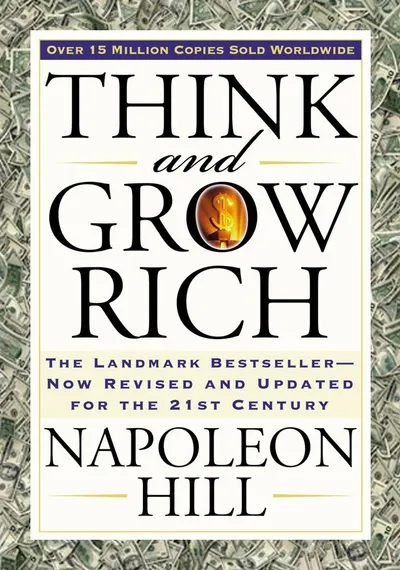
Think and Grow Rich
Key Takeaway
There is a massive difference between wishing for something and having a burning desire for it. A wish is passive. A burning desire comes with a plan, a deadline, and a willingness to sacrifice. Most people never cross that line, and that’s why most people stay exactly where they are.
The Big Picture
- A burning desire backed by a definite plan is the starting point of all achievement, not talent, not luck, not connections
- Your subconscious mind can be programmed through repeated thought and belief, what Hill calls “auto-suggestion”
- The people you surround yourself with (your “Mastermind”) shape your thinking, your standards, and your financial ceiling
- Persistence is the most underrated trait in success. The most common cause of failure is the habit of quitting when things get hard
Why This Book Matters
Let me be honest with you upfront. This is a complicated book to recommend.
Think and Grow Rich was published in 1937. It’s widely considered the grandfather of self-help, the book that launched an entire industry. Every personal development author you’ve ever read, Tony Robbins, James Clear, Robert Kiyosaki, they’re all downstream from Napoleon Hill whether they credit him or not. The ideas in this book have been recycled, repackaged, and resold for almost a century.
And some of those ideas genuinely hold up.
But the book comes with serious baggage. Napoleon Hill’s personal credibility is questionable at best. He claims he spent twenty years interviewing Andrew Carnegie and 500 of America’s most successful people. Historians have struggled to verify most of those claims. The Carnegie interview, the one the entire book is supposedly based on, has never been independently confirmed. Some of Hill’s biographical details don’t check out at all.
Here’s the thing: Hill was essentially the Robert Kiyosaki of his era. Better at packaging ideas than proving them. Better at selling the dream than documenting the receipts. If you’ve read my notes on Rich Dad Poor Dad, you know I have the same tension with Kiyosaki. The messenger is suspect, but some of the message still lands.
So why did I still read it? Because understanding where ideas come from matters. When James Clear writes about persistence in Atomic Habits, he’s giving you Hill’s framework with better science and cleaner writing. When Maxwell Maltz describes self-image programming in Psycho-Cybernetics, he’s giving you the clinical version of Hill’s “auto-suggestion.” When Naval talks about “specific knowledge” in The Almanack of Naval Ravikant, he’s echoing Hill’s “specialized knowledge,” written eighty years apart.
This book is a historical document as much as a self-help book. Read it to understand where the genre started. But for the practical version of these ideas, you’re better off reading the books that built on Hill’s foundation and actually backed them up with evidence.
Core Concepts
Burning Desire: The Starting Point
Hill’s most powerful distinction. And the one that actually changed something in me.
A wish is “I’d like to make more money someday.” A burning desire is “I will build something that generates income by this date, and here is exactly what I’m willing to sacrifice to make it happen.”
Most people wish. Almost nobody burns.
I lived this distinction firsthand. For years, I wished for a different career. I wished I could build something of my own. I wished I didn’t have to trade time for a paycheck indefinitely. And nothing happened. Because wishes don’t create momentum. They create daydreams.
The shift happened when wishing turned into something that kept me up at night. When I stopped saying “it would be nice to build something” and started saying “I have to build this, and here’s the plan.” That wasn’t a subtle change. It was a fundamentally different relationship with the goal. The plan got specific. The timeline got real. The sacrifices became obvious and I made them anyway.
Hill argues that this burning desire is the prerequisite for everything else in the book. Without it, the other principles are academic exercises. I think he’s right about that.
Faith and Auto-Suggestion
This is where Hill starts to sound like a self-help preacher, and honestly, the language hasn’t aged well. But strip away the 1937 vocabulary and there’s a real idea underneath.
Hill’s claim: your subconscious mind accepts whatever you repeatedly tell it, and then acts on it as if it’s true. Feed it thoughts of poverty and failure, and it steers you toward poverty and failure. Feed it thoughts of abundance and capability, and it steers you toward those instead.
Sound familiar? It should.
Maxwell Maltz turned this exact idea into the servo-mechanism theory in Psycho-Cybernetics, the idea that your brain is a goal-seeking machine that navigates toward whatever self-image you hold. Maltz gave it clinical language, case studies from plastic surgery patients, and a framework you can actually use. Hill had the intuition. Maltz had the science.
And James Clear’s identity-based habits in Atomic Habits? “Every action is a vote for the type of person you wish to become.” That’s auto-suggestion through behavior instead of affirmation. Same underlying principle, modernized and made practical.
Hill was pointing at something real. He just didn’t have the tools to explain why it works. Now we do.
Specialized Knowledge
General knowledge, no matter how much of it you accumulate, is almost useless. What matters is specialized knowledge, organized and directed toward a specific purpose.
Hill makes a distinction that I think is underappreciated: knowing something is not the same as knowing how to use it. Universities are full of professors who know everything about a subject and have no idea how to turn that knowledge into value. The person who wins isn’t the one who knows the most. It’s the one who knows how to apply what they know.
Naval Ravikant calls this “specific knowledge” in The Almanack of Naval Ravikant. Knowledge that’s found by following your genuine curiosity, not by sitting in a classroom. Knowledge that looks like play to you and work to everyone else. Hill said it in 1937. Naval said it in 2020. The idea is the same, and in an era where AI handles the generic, it matters more than ever.
Your specialized knowledge is the thing you’ve built through obsession and experience that can’t be replicated by someone reading a textbook. Or by a chatbot.
The Mastermind Principle
Surround yourself with people who elevate your thinking. Hill calls this the “Mastermind,” a group of people who come together with a shared purpose, pooling their knowledge, experience, and energy toward a common goal.
This is the concept from the book that I’ve found most practically useful.
Here’s why. Growing up, nobody in my immediate circle talked about building businesses, investing, or financial independence. The people around me worked hard, earned their paychecks, and spent them. That was the model. And when your environment sets the ceiling for what feels normal, you don’t even realize the ceiling exists.
When I started spending time around people who thought differently about money, who talked about assets and equity and leverage, my own thinking shifted without conscious effort. Not because they lectured me. Just because proximity reprograms what feels possible. Your Mastermind doesn’t have to be a formal group. It’s the five conversations you have most often. The voices in your ears during your commute. The people whose standards become your baseline.
Think about it. If everyone around you is comfortable, you’ll be comfortable. If everyone around you is building, you’ll build.
I think about this every time I consider the goal of helping my parents retire someday. That desire wasn’t something I came up with in isolation. It emerged from being around people who thought about money as a tool for freedom, not just survival. The Mastermind principle in action, even if I never called it that.
Persistence
Hill calls persistence the “sustained effort necessary to induce faith.” Less poetically: keep going when it gets hard, because that’s where everyone else stops.
The most common cause of failure, according to Hill, is not lack of talent or resources. It’s the habit of quitting at the first sign of difficulty. Or the second. Or the third.
James Clear repackaged this beautifully with his “never miss twice” rule in Atomic Habits. Miss a day? Fine. Miss two days in a row? That’s the start of a new pattern. Hill’s version is less structured but hits the same nerve. The difference between the people who make it and the people who don’t is almost never intelligence or connections. It’s the ability to absorb a punch and keep walking forward.
Tony Robbins built his entire career on Hill’s foundation, and persistence is at the core of it. Robbins’ “Awaken the Giant Within” is essentially Hill’s principles supercharged with 1990s intensity and NLP language. Same bones, different muscle.
What I’ve Found Most Useful
The desire vs. wish distinction as a personal filter. When I catch myself saying “I want to do X,” I now ask: is this a wish or a burning desire? If I don’t have a plan, a timeline, and a willingness to sacrifice for it, it’s a wish. And wishes don’t build anything. This filter has helped me stop lying to myself about what I actually care about.
The Mastermind principle as an environment audit. I periodically look at who I’m spending the most time with and what conversations dominate my week. If the conversations are about complaints and comfort, I know I need to change the inputs. Your environment programs you whether you consent to it or not.
Persistence as identity, not effort. I stopped thinking of persistence as “trying harder” and started thinking of it as “being the person who doesn’t quit.” That’s a self-image shift, which connects right back to Maltz. You don’t grit your teeth through difficulty. You become someone for whom quitting isn’t an option.
Memorable Quotes
“The starting point of all achievement is desire. Keep this constantly in mind. Weak desire brings weak results, just as a small fire makes a small amount of heat.”
“Whatever the mind can conceive and believe, it can achieve.”
“Before success comes in any man’s life, he is sure to meet with much temporary defeat, and, perhaps, some failure. When defeat overtakes a man, the easiest and most logical thing to do is to quit. That is exactly what the majority of men do.”
Final Thoughts
Let’s be real: this book is a product of 1937. You’ll feel it on every page.
The language is preachy and repetitive. Hill makes his point, then makes it again, then makes it a third time with a slightly different anecdote. Some chapters feel like sermons. The writing assumes a very specific audience, men of a certain era with certain ambitions, and it shows. The “transmutation of sex energy” chapter is bizarre by modern standards. I’d skip it entirely. And the “infinite intelligence” chapter, where Hill veers into mysticism about a “sixth sense” that gives you access to universal knowledge, has no evidence behind it and reads like it belongs in a different book.
Then there’s Hill himself. I mentioned his credibility issues earlier, but they’re worth repeating. The Andrew Carnegie interviews that form the backbone of the entire book may not have happened as described. Hill’s biographical claims are riddled with gaps. He was, at his core, a salesman. Brilliant at synthesizing ideas into compelling narratives, questionable at documenting where those ideas actually came from.
But here’s what I keep coming back to.
Strip away the dated language, the mysticism, the dubious biography, and three ideas survive the test of time. The burning desire framework, because wishing and wanting are genuinely different things and most people never make the leap. The Mastermind principle, because who you surround yourself with does determine the ceiling of your thinking. And persistence, because quitting is still the most common cause of failure, ninety years later.
Every personal development book written after 1937 is building on this foundation. Psycho-Cybernetics is the scientific upgrade to auto-suggestion. Atomic Habits is the practical system for persistence. The Almanack of Naval Ravikant is specialized knowledge for the internet age. These books took Hill’s raw material and refined it into something you can actually use.
So should you read Think and Grow Rich? If you’re interested in where self-help came from, yes. If you want to understand the DNA that every modern personal development book carries, yes. But if you want actionable frameworks that work in your actual life, read the descendants instead. They inherited the best parts and left the rest behind.
This is a museum piece. A genuinely important one. But you don’t live in a museum.
— filed under pockets

David Vo
Writing about mindset, purpose, money, and building with AI, from Montreal. Breaking free from autopilot, one system at a time.