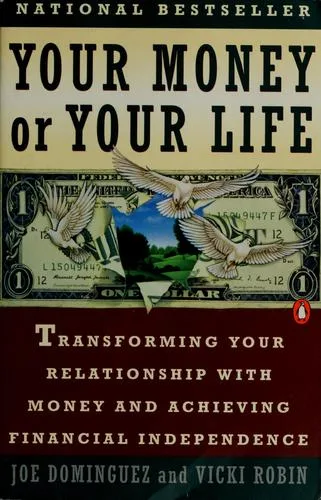
Your Money or Your Life
Key Takeaway
Money isn’t abstract. It’s your life energy, the hours you’ll never get back, traded for dollars. Once that reframe clicks, every purchase becomes a question: Is this worth the hours of my one irreplaceable life?
The Big Picture
- Every dollar you earn costs you a specific number of hours, your life energy, and it’s a non-renewable resource
- There’s a point on the spending curve where more money stops creating more happiness, and most people blow right past it
- Your real hourly wage is drastically lower than you think once you factor in the hidden costs of working
- Financial independence isn’t a number, it’s the crossover point where your investment income exceeds your expenses
Why This Book Matters
I need to give you some context on this one.
Before Die With Zero. Before The Simple Path to Wealth. Before Ramit Sethi’s automation systems and Morgan Housel’s behavioural insights, there was this book. Published in 1992. Written by two people who had already achieved financial independence and wanted to show others how.
This is the book that started the FIRE movement. Not officially, not with that label, but the entire philosophy of Financial Independence, Retire Early traces back to this book’s DNA. Every FIRE blogger, every subreddit, every “savings rate” calculator owes something to Robin and Dominguez.
I found it the way most people in that world do, deep in the rabbit hole.
I was tracking my savings rate. Running compound interest calculators at midnight. Every FIRE community I joined had the same book at the top of their “start here” lists. So I read it.
The thing that hit me wasn’t the tactics. It was the reframe.
I’d been thinking about money the way most people do, as something you earn and spend and try to have more of. Robin and Dominguez flipped that completely. Stop thinking about money as money. Start thinking about it as your life energy. Every dollar you earn cost you a specific amount of your finite, irreplaceable time on this planet.
That single idea changed how I look at every purchase. Not “can I afford this?” but “is this worth X hours of my life?”
And honestly? Watching my parents trade decades of life energy without ever questioning the exchange, working jobs that drained them, deferring everything to a “someday” that kept moving, this book gave me the language for what I’d been feeling but couldn’t articulate.
Core Concepts
Money = Life Energy
This is the foundational idea. Everything else in the book builds on it.
Here’s the logic: you have a finite number of hours on this planet. Some of those hours, you trade for money. That money isn’t just currency, it’s you. It’s hours of your life, converted into a number in your bank account.
When you buy a $200 pair of sneakers, you’re not spending $200. You’re spending however many hours of your life it took to earn that $200. If your real hourly wage is $20 (more on that in a second), those sneakers cost you 10 hours. Ten hours of your one life.
Read that again.
Once this clicks, you stop making unconscious purchases. You can’t. Because every price tag now has a second number attached to it, a number measured in the only currency that actually matters.
I went from “how much does this cost?” to “how many hours of my life does this cost?” And those are fundamentally different questions.
Your Real Hourly Wage
This is where the book gets uncomfortable. In a good way.
You think you know what you earn per hour. If you make $60,000 a year and work 40 hours a week, that’s roughly $30 an hour. Simple math.
But Robin and Dominguez say: that’s not your real hourly wage. Because you’re not accounting for all the hidden costs of working.
Factor in:
- Commute time and costs, gas, transit, wear on your car
- Work wardrobe, the clothes you’d never buy if you didn’t have to show up somewhere
- Decompression time, the hours after work where you’re too drained to do anything meaningful
- Convenience spending, takeout because you’re too tired to cook, the $7 coffee because you need to survive the afternoon
- Childcare, if applicable, the cost of someone else watching your kids while you work
When you subtract all those costs from your salary and add all those hours to your work time, your $30/hour job might actually be a $15/hour job. Maybe less.
That calculation shook me. Not because the math was hard, because the truth was hard. I was spending more of my life energy on work than I’d ever realized.
The Fulfillment Curve
This might be the most important graph in personal finance.
Robin and Dominguez describe a curve: as your spending increases from zero, your fulfillment rises. Survival to comfort to luxury. Each dollar buys real happiness.
But then the curve peaks. And after that peak, more spending doesn’t create more fulfillment, it actually decreases it. The bigger house comes with bigger maintenance, bigger stress, bigger mortgage payments. The luxury car needs premium gas, expensive insurance, constant anxiety about scratches. You’re spending more and enjoying life less.
The peak of that curve? That’s “enough.”
“Enough” isn’t deprivation. It’s the point where your spending perfectly aligns with your actual fulfillment. Below it, you’re suffering unnecessarily. Above it, you’re just converting life energy into clutter, status, and stress.
Housel gets at this same idea in The Psychology of Money, his chapter on “enough” is essentially Robin’s fulfillment curve compressed into 15 pages. The person who can’t define “enough” will never feel wealthy, no matter what their portfolio says.
The Crossover Point
This is the FIRE moment. The entire movement orbits this concept.
The crossover point is when your monthly investment income, the passive money your portfolio generates, exceeds your monthly expenses. That’s it. That’s financial independence. Not a million dollars. Not a specific number. Just the point where you no longer need to trade your life energy for money.
Collins’ The Simple Path to Wealth gives you the investment vehicle to get there. VTSAX, low costs, stay the course. But Robin gives you the philosophical framework for why you’re doing it. Collins is the how. Robin is the why.
The math is straightforward. But I’ll be honest, it requires significant discipline and a decent income to reach in any reasonable timeframe. The book doesn’t fully grapple with how much harder this is for lower earners. The math on a $35,000 salary with student debt and rising rent? That’s a different conversation.
Tracking Every Penny
Robin’s system asks you to track every single cent that enters or leaves your life. Not to restrict spending, to create awareness.
Most people have no idea where their money actually goes. They earn, they spend, the month ends. Tracking breaks the trance. When you see that you spent $400 on takeout last month, you’re not being told to stop, you’re being asked: Was that worth the hours of life energy it cost you?
Here’s where I’ve evolved, though. Robin’s original system is fully manual. Pen and paper. Every receipt. In 1992, that was the only option. In 2024, it feels like using a typewriter when you have a laptop.
Ramit Sethi’s automated system, from I Will Teach You To Be Rich, is the modern version. Set up your accounts, automate your flows, and your money goes where it should without you white-knuckling a spreadsheet every night. Sethi’s “conscious spending plan” is Robin’s philosophy with better technology.
”Enough”. The Most Powerful Word in Personal Finance
This concept threads through the entire book, but it deserves its own space.
“Enough” isn’t a number. It’s a relationship with your needs. Knowing what genuinely fulfills you and refusing to spend life energy on things that don’t.
Think about it. Most financial stress isn’t caused by not having enough. It’s caused by not knowing what enough looks like. The goalpost keeps moving. You hit a savings target and immediately set a higher one. You earn more and spend more. The treadmill never stops because you never defined the destination.
Robin says: define it. Draw the line. Know what “enough” looks like for you, not for Instagram, not for your neighbours, not for the version of you that’s trying to impress people who don’t care.
What I’ve Found Most Useful
The “life energy” reframe changed my purchasing behaviour permanently. I still do this, mentally converting prices into hours before I buy. A $50 dinner? That’s about three hours of work. Worth it with good friends. Not worth it for mediocre food I won’t remember. The calculation takes two seconds and saves me from hundreds of unconscious purchases.
The real hourly wage calculation was a wake-up call. The gap between my “official” hourly rate and my actual hourly rate was bigger than I expected. That gap justified questioning whether a higher-paying job with a brutal commute was actually higher-paying at all.
The tension between this book and Die With Zero became my operating philosophy. Robin says “stop wasting life energy on stuff.” Perkins says “start spending life energy on experiences.” Together, they’re the complete picture. Robin protects you from mindless consumption. Perkins protects you from mindless accumulation. I needed both, and I suspect you do too.
My evolution from frugality to balance. I initially took this book’s message too far. Went hardcore. Tracked obsessively. Cut spending to the bone. For a while, it worked. But over time, it felt like I was optimizing my life for money instead of with money. Die With Zero cracked that open. Spending intentionally on what matters, cutting ruthlessly on what doesn’t, that’s where I’ve landed. Healthier than either extreme.
Memorable Quotes
“Money is something we choose to trade our life energy for.”
“The key is remembering that anything you buy and don’t use, anything you throw away, anything you consume and don’t enjoy is money down the drain, and you are the one who pays.”
“Financial Independence is the experience of having enough, and then some.”
Final Thoughts
Let’s be real: this book shows its age. The original edition is from 1992, and some of the advice, manual tracking, investment vehicles that are no longer relevant, a vibe that occasionally drifts into commune-living territory, feels dated even in the updated editions. Robin’s lifestyle was extremely minimalist. That’s fine for her. It’s not a template for everyone.
The frugality emphasis can tip into something unhealthy. I watched people in FIRE communities take this book’s message and turn it into deprivation, eating rice and beans for years, never spending on anything that brought joy, all to hit the crossover point six months faster. That’s not financial independence. That’s just a different kind of prison.
And the crossover point math doesn’t account for variable income, health emergencies, or simply living in a city where rent takes 40% of your paycheque before you’ve done anything else. The book implies a level of control over your finances that’s harder to achieve than it lets on.
But here’s where I land on it.
The “money = life energy” reframe is one of the most powerful concepts in personal finance. Full stop. Once you internalize it, really internalize it, not just nod along, you’ll never make an unconscious purchase again. Every transaction becomes a choice instead of a reflex. That alone makes this book worth reading.
This is the philosophical foundation of the entire FIRE movement. Collins’ index fund strategy? It’s the investment vehicle for the journey Robin mapped out. Sethi’s conscious spending? Robin’s tracking system with better software. Housel’s “enough”? Robin’s fulfillment curve in miniature. Ferriss’ “time > money” philosophy? It started here, whether he’d admit it or not.
Everything built on this.
I’ve moved past the hardcore frugality phase. I spend on experiences now. I budget for joy. I don’t track every penny manually, I’ve got systems for that. But the question this book planted in my head, how many hours of my life is this worth?, that never left.
And honestly, I don’t want it to.
— filed under pockets

David Vo
Writing about mindset, purpose, money, and building with AI, from Montreal. Breaking free from autopilot, one system at a time.