From the archive — written in 2021, before this site became what it is now.
programmingThe 80/20 Rule: How to Apply It To Your Life and Achieve More

What is the 80/20 rule?
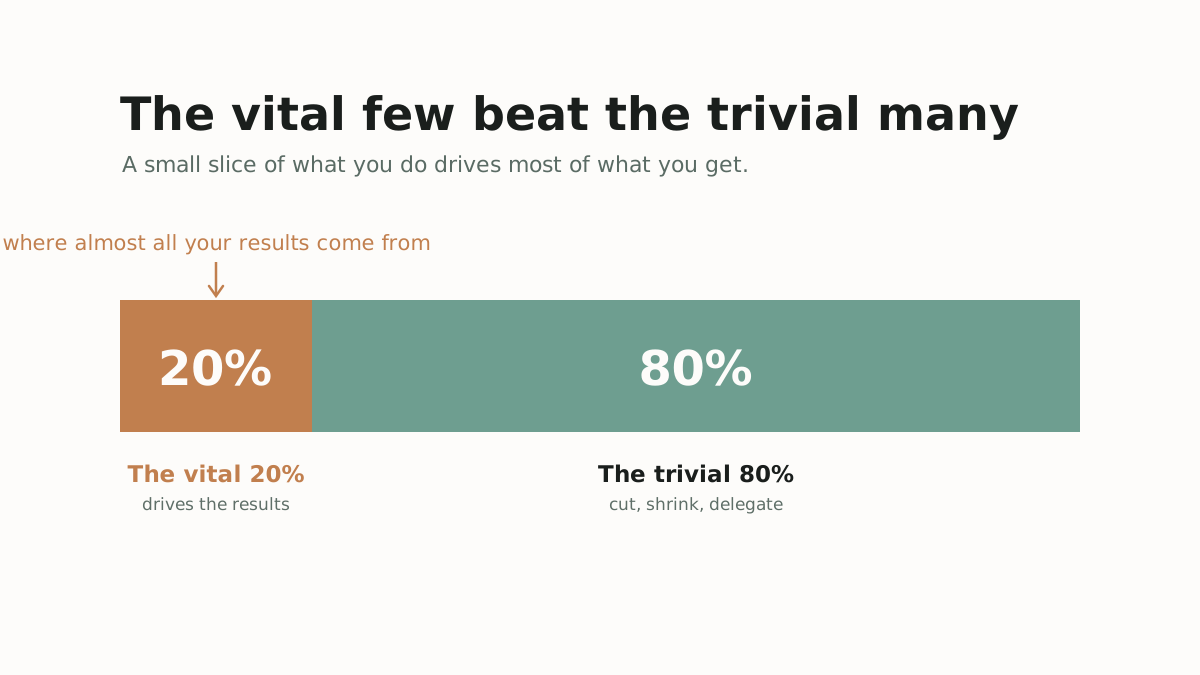
The 80/20 rule, or Pareto principle, states that “80% of effects come from 20% of causes.” This concept originated from Italian economist Vilfredo Pareto, who observed that a minority of the population controlled the majority of wealth and land. He termed this the “vital few and trivial many.”
How to apply the 80/20 rule in your life
Business
In business contexts, a small percentage of customers typically generate the majority of revenue. These key clients deserve prioritization over less profitable relationships.
Relationships
Many couples experience recurring conflicts stemming from just a few unresolved issues, despite general harmony most of the time.
Workplace productivity
Time-consuming activities like email overload, disorganized systems, duplicate efforts, interruptions, and unnecessary meetings should be identified and eliminated.
Time management
Most people concentrate their efforts on a limited set of activities while neglecting others. Success comes from focusing on your most important tasks than trying to do everything at once.
Personal life
Prioritizing meaningful relationships with close family and friends matters more than countless casual online interactions.
Why is Pareto’s principle important?
This principle emphasizes that not all tasks carry equal importance. Some can be delegated, minimized, or eliminated entirely. It prevents overwhelming feelings by encouraging focus on the vital few rather than attempting everything simultaneously.
A practical example involves weight loss: identifying calorie-dense foods like daily ice cream servings and removing them could significantly reduce overall consumption with minimal effort.
Applying the 80/20 rule for time management
The concept of “focused productivity” means investing effort where it generates meaningful results. Many people complete numerous to-do items without accomplishing their most important objectives. Productivity is achieved by optimizing your inputs and outputs rather than merely tracking hours worked.
Working on wrong tasks wastes valuable time and energy. Until identifying the most efficient activities, individuals may squander resources. By eliminating unproductive tasks, people gain freedom for genuinely important work.
Using the Pareto Rule to Achieve Success in Life
Too much time gets spent on activities providing minimal value — endless social media scrolling, television watching, or researching productivity tools. Instead, dedicate energy to meaningful work. People often claim insufficient time exists, when actually they fail to make enough time for the right stuff.
How to apply the 80/20 rule in 5 steps
Step 1: Catalog all daily activities, habits, possessions, and relationships.
Step 2: Answer relevant questions such as:
- Which tasks consume significant time yet yield minimal results?
- Which activities fulfill you most while requiring little time?
- Which few behaviors cause relationship conflicts?
- Who makes you happiest?
- Which foods appear most frequently in your diet?
- Which foods offer optimal or minimal nutrition?
Step 3: Establish goals aligned with the most valuable answers from step two.
Step 4: Create an implementation plan focusing on high-value actions. A solid plan will serve as your north star for deciding which opportunities you should say yes and no to.
Step 5: Execute the plan daily until it becomes routine habit.
The Takeaway
Pareto’s principle provides an effective framework for prioritizing time and energy toward maximum-value activities rather than attempting everything simultaneously. Once identifying what truly matters, creating goals and plans around these priorities enables greater achievement across all life areas.
— filed under programming, December 2021

David Vo
Writing about mindset, purpose, money, and building with AI, from Montreal. Breaking free from autopilot, one system at a time.
Related articles
The GenAI Guide: How to Actually Use AI (Without the Hype)
A plain-English, model-agnostic guide to using AI at work and in life. What an LLM is, why it's for you, how to pick and test models yourself, and the guardrails that keep you in charge.
The Boredom Advantage: Why Your Inability to Be Bored is Killing Your Breakthroughs
Boredom isn't a void to be filled - it's the loading screen for your next breakthrough. Learn the science behind dopamine depletion, why the world's greatest thinkers engineered empty space, and a practical reset protocol to reclaim your focus.