The Boredom Advantage: Why Your Inability to Be Bored is Killing Your Breakthroughs
Boredom isn't a void to be filled - it's the loading screen for your next breakthrough. Learn the science behind dopamine depletion, why the world's greatest thinkers engineered empty space, and a practical reset protocol to reclaim your focus.
The Slot Machine in Your Pocket
You’re standing in line at the grocery store. Four people ahead of you.
Your hand is already in your pocket. Thumb swiping before you’ve even registered what you’re looking at. Instagram. X. Back to Instagram. Nothing new. Swipe anyway.
You didn’t decide to do this. It just… happened.
Sound familiar?
We’ve all been there. That moment where the slightest gap in stimulation - a line, a red light, a loading screen - sends us scrambling for our phone like it’s an oxygen mask.
Here’s a quick test: Can you stand in a line for two minutes without reaching for your phone? Not “choose not to.” Can you?
If the answer is no, your dopamine system has been reprogrammed. And it happened without your consent.
But this isn’t an article about how your phone is ruining your life. You’ve read that one already.
This is about something most people miss entirely: boredom is a competitive advantage. And the inability to tolerate it is quietly killing your ability to have any kind of breakthrough - personal or professional.
Boredom isn’t a void to be filled. It’s a loading screen. And you keep hitting “cancel” right before the download completes.
The Dopamine Trap
Let’s talk about dopamine, because most people get it wrong.
Dopamine isn’t the “pleasure chemical.” It’s the anticipation chemical. The molecule of “more.” Of “what’s next?”
This distinction matters.
When you check your phone, the dopamine spike doesn’t come from the message. It comes from the possibility of a message. The uncertainty of what might be waiting.
Neuroscientist Robert Sapolsky spent decades studying this. His research on reward uncertainty showed that dopamine fires highest not when you receive a reward, but when the reward is unpredictable. Sometimes there’s a notification. Sometimes there isn’t. Sometimes it’s exciting. Usually it’s nothing.
That’s the exact mechanic behind a slot machine.
Your phone is a slot machine you carry voluntarily, pull 150 times a day, and wonder why you feel depleted by noon.
Dr. Andrew Huberman frames it through what he calls your “dopamine baseline” - the resting level of dopamine your brain considers normal. Every massive spike creates a corresponding crash below baseline. The higher the spike, the deeper the valley.
So those quick dopamine hits from scrolling? They’re not free. They’re borrowed against your future motivation. Every swipe pulls your baseline a little lower. And when your baseline drops, everything that isn’t a screen - work, conversation, exercise, thinking - feels unbearable.
Dr. Anna Lembke, author of Dopamine Nation, describes it as a seesaw. Pleasure on one side, pain on the other. The brain always seeks balance. Flood the pleasure side and the brain compensates by tipping toward pain. That “blah” feeling after a Netflix binge isn’t laziness. It’s neurochemistry doing exactly what it’s designed to do.
Here’s the part that changes everything: the activities leading up to a reward release more dopamine than the reward itself. The anticipation of checking your phone is the high. The moment after you check it is the crash.
We’re chasing the pull of the lever, not the jackpot.
Your Brain’s Best Work Happens in the Gaps
So what happens when you actually let yourself be bored?
Something remarkable.
Neuroscientists call it the Default Mode Network - the brain’s background processing system that activates when you’re not focused on any external task. Daydreaming. Staring out a window. Walking without a podcast.
This network is responsible for some of your brain’s most important work: connecting unrelated ideas, processing emotions, consolidating memory, and generating creative insight.
But it only activates when you stop feeding it input.
Every time you fill a gap with a scroll, you’re shutting down the system responsible for your best thinking. You’re choosing noise over signal, repeatedly, hundreds of times a day.
Steven Pressfield calls this pattern “The Resistance” - that invisible force that shows up whenever you’re about to do meaningful work. Boredom is one of Resistance’s favorite disguises. It whispers that you need a break. That you should just check one thing. That you’ll come back to it in a minute.
You won’t.
In 2014, a study published in Science gave participants a choice: sit alone with their thoughts for 15 minutes, or receive an electric shock. 67% of men and 25% of women chose the shock.
We would literally rather experience physical pain than sit with our own minds.
Let that sink in.
If you can sit with boredom - truly sit with it, without reaching for an escape hatch - you’re already outperforming the majority. Not because you’re disciplined. Because your brain’s background processor is actually running.
The Monastic Habits of Greatness
This pattern isn’t theoretical. The people who’ve produced the most original thinking in history didn’t just tolerate boredom - they engineered it.
Charles Darwin walked the same gravel path behind his house every single day. The “Sandwalk,” he called it. Same loop, same view, same boring rhythm. He used the monotony as a thinking tool. The theory of evolution wasn’t born in a flash of inspiration. It was processed, piece by piece, on a path designed to eliminate every distraction except thought itself.
Naval Ravikant is perhaps the most vocal modern advocate for this idea. He argues that “busy-ness” is a sign of poor judgment, not productivity. High-level success comes from making two or three great decisions per year, not completing a thousand tasks. His prescription is radical: sit in a room for 60 minutes with no devices. Just your thoughts. He calls it the “Art of Doing Nothing.” Naval often points out that 99% of effort is wasted - boredom is the filter that helps you see the 1% that matters. As he puts it: “You’ll do better work if you’re bored rather than busy. If you’re too busy doing stuff, you won’t have time to think clearly.”
Steve Jobs took this further by designing it into his physical environment. His homes and workspaces were famously minimal. Empty rooms. Bare walls. Most people saw austerity. Jobs saw space. The emptiness in his environment created the conditions for fullness in his products.
Three different people. Three different eras. The same pattern: breakthroughs don’t happen despite boredom. They happen because of it.
These people didn’t stumble into empty space. They built it on purpose.
The Bridge to Flow
Here’s where boredom connects to something you’ve probably experienced but couldn’t name.
That state where time disappears. Where your performance spikes and effort feels effortless. Where you’re so locked into what you’re doing that someone could call your name three times and you wouldn’t hear it.
Mihaly Csikszentmihalyi called it “Flow.” And it’s not random.
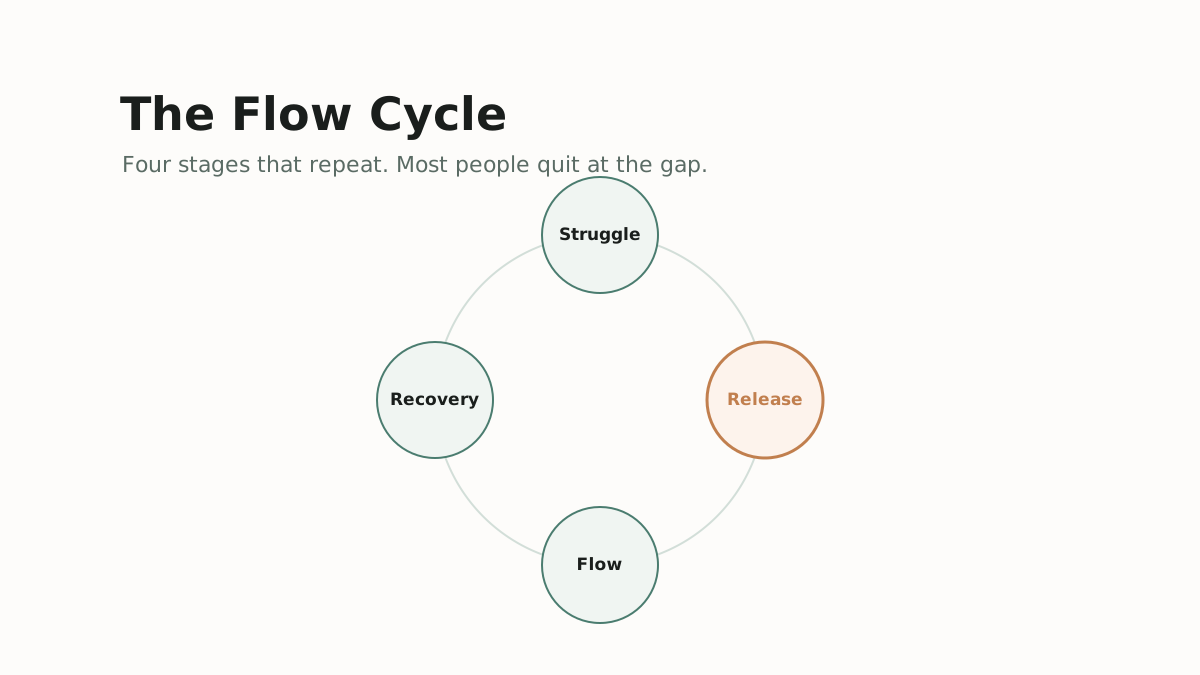
Flow follows a predictable cycle with four stages:
Stage 1: Struggle. The initial frustration. The task feels hard. Your brain resists. This is where the itch to grab your phone is loudest. Most people bail here.
Stage 2: Release. You stop forcing it. You let go. This is the boredom moment - the gap where your brain shifts from active grinding to background processing. The loading screen.
Stage 3: Flow. The breakthrough. Effortless high performance. Ideas connect. Time bends. This is the state everyone wants and almost nobody earns, because they keep interrupting Stage 2.
Stage 4: Recovery. The necessary reset before the next cycle. Rest. Reflection. Integration.
The critical insight: you can’t skip Stage 1 and 2. The struggle and the boredom are the price of admission.
Every time you bail out of discomfort with a dopamine hit - checking your phone, switching tabs, opening a new app - you restart the cycle from zero. You never make it past the loading screen.
Flow happens when you’re bored enough to be focused but challenged enough to be engaged. Csikszentmihalyi called it the “challenge-skill balance” - the task needs to stretch you about 4% beyond your current ability. Not so hard you panic. Not so easy you zone out. Right at the edge.
But you’ll never find that edge if you can’t sit through the first ten minutes of discomfort.
This is what “flow, don’t force” actually means in practice. You design your environment to survive the struggle phase. And the flow follows.
The Reset Protocol
You’re probably convinced the problem is real at this point. Now the question is: what do you do about it?
The good news is that dopamine receptors recover. Your brain isn’t permanently rewired. But it does need deliberate intervention to recalibrate.
Here’s the protocol.
Protect Your Attention Like Your Wallet
A study from UC Irvine found that after a single interruption, it takes an average of 23 minutes to fully re-engage with a task. Not 23 seconds. Twenty-three minutes.
Every phone check during deep work doesn’t cost you the five seconds of looking at the screen. It costs you 23 minutes of cognitive re-entry. Five checks in a work session? You just lost almost two hours to attention residue.
Block your deep work time. Put the phone in another room - not on silent, not face-down, in another room. Remove the option entirely.
Environment is stronger than willpower. Always has been.
Train the “Wait 10 Minutes” Muscle
Feel the urge to check your phone? Don’t fight it. Just wait 10 minutes.
That’s it. No willpower speech. No discipline framework. Just: not yet.
What you’re actually doing is training your prefrontal cortex - the rational, long-term-thinking part of your brain - to override your limbic system, the part screaming for instant reward. Each time you wait, the prefrontal cortex gets a little stronger. The urge gets a little quieter.
Start with 10 minutes. Then 20. Then an hour. The muscle builds faster than you’d expect.
Replace the Spike with the Steady
The goal isn’t to eliminate dopamine. It’s to shift from spike-and-crash sources to sustainable, slow-release sources that raise your baseline instead of crashing it.
Walking and exercise: Physical movement triggers Brain-Derived Neurotrophic Factor (BDNF) - essentially fertilizer for your brain. It strengthens the neural pathways responsible for focus, learning, and mood regulation. A 30-minute walk does more for your cognitive performance than an hour of scrolling ever will.
Meditation and Non-Sleep Deep Rest (NSDR): Huberman’s research suggests that practices like Yoga Nidra can increase baseline dopamine levels by up to 65%. Not a spike followed by a crash. A genuine, sustained elevation of your resting state. Your “bored” starts to feel better.
Analog capture - writing by hand: There’s a reason every productivity system comes back to pen and paper. Handwriting forces your brain to slow down to processing speed. It’s a “second brain” safety net - thoughts captured without the distraction of a screen.
Cooking. Reading. Conversation. These aren’t glamorous. They won’t give you a rush. That’s the point. They’re training your brain to find reward in the process, not the ping.
The activities leading up to the reward release more dopamine than the reward itself. So choose activities where the doing is the point. A walk with no destination. A book with no deadline. A meal cooked slowly.
That’s where your baseline rebuilds.
The Monotony of Mastery
We romanticize breakthroughs.
The flash of insight. The eureka moment. The overnight success.
From the outside, they look dramatic. From the inside? They’re just the result of doing the boring thing a thousand times without reaching for an escape hatch. Darwin walking the same gravel loop. Naval sitting in silence. Jobs staring at an empty room.
The people who break through aren’t the ones with the most stimulation. They’re the ones who can tolerate the least.
Blaise Pascal wrote it in 1654 and we still haven’t listened: “All of humanity’s problems stem from man’s inability to sit quietly in a room alone.”
Almost 400 years later, we’ve built an entire economy designed to make sure you never have to.
The counter-intuitive approach is to opt out.
Put the phone in another room. Not tomorrow. Right now. Give yourself 30 minutes of nothing.
Let the boredom do its work.
The loading screen is where everything begins.