The Compound Effect of Small Actions
The daily workout, the daily junk. Their effect feels so distant it barely matters today. Except it does, over time.

Everything starts with small actions that are easy to overlook. That daily workout, or that daily scroll on the couch. That daily junk food, or that daily home-cooked meal.
Their effect feels so distant that it almost doesn’t matter in the moment, right?
Except it does… over time, that is.
One day decides almost nothing
Here’s the problem with small actions: on any given day, they’re invisible.
Skip one workout and nothing happens. Eat one burger and you look exactly the same in the mirror the next morning. Put $50 into your TFSA and your balance barely moves. So you tell yourself it doesn’t matter, and on that one day, you’re right.
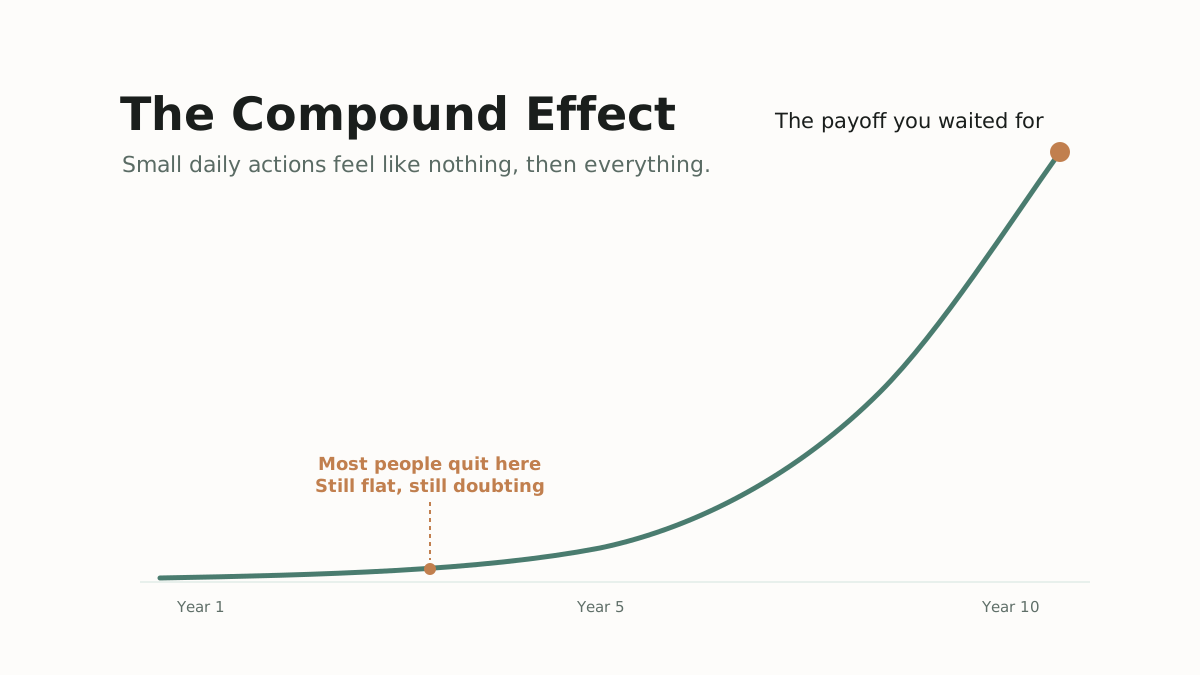
The catch is that you never live just one day. You live the same day hundreds of times in a row, and whatever you repeat is what you become.
Darren Hardy built a whole book around this idea, The Compound Effect: it isn’t the big moments that separate people in the end, it’s the thousands of tiny choices nobody sees.
The math of 1%
Say you get 1% better at something every single day for a year. That’s 1.01 multiplied by itself 365 times, which comes out to about 38.
Now say you get 1% worse every day instead. That’s 0.99 to the power of 365, and you’re left with about 3% of where you started.
Same small days. Opposite directions.
And for the first few weeks you honestly can’t tell the two paths apart, which is exactly why most people quit right before it starts to show.
James Clear puts it best in Atomic Habits:
“Habits are the compound interest of self-improvement. The same way that money multiplies through compound interest, the effects of your habits multiply as you repeat them.” James Clear, Atomic Habits
If you’ve read my notes on money, you know how compound interest works on a portfolio. Your habits are the exact same mechanism, pointed at your body, your skills and your relationships.
Why we struggle with it
We celebrate destinations. The transformation photo, the exit, the “overnight” success. Nobody posts day 43 of the boring version.
So we set huge goals that feel exciting for a week and impossible by the second, and we quit. The goal wasn’t wrong. It was just built for motivation, and motivation doesn’t compound. Repetition does.
Start smaller than feels useful
Pick the habit you want, then shrink it until it feels almost silly.
- Want to get fit? Ten push-ups after you brush your teeth. Not a 6 a.m. bootcamp.
- Want to read more? One page before bed.
- Want to invest? An automatic transfer, even a small one, on payday.
- Want to focus? Put the phone in a drawer. I used to keep mine on my desk and wonder why I couldn’t focus.
Small actions have almost no resistance, so you actually do them on the bad days too. That’s the whole trick. Consistency beats intensity because intensity doesn’t show up on a Tuesday when you’re tired.
Then let the identity do the work. Every rep is a vote for the person you’re becoming: someone who trains, someone who reads, someone who invests.
Which way did today go?
You’re already compounding. Everyone is. The only question is in which direction.
So look at today. Not the year, not the five-year plan. Just today. Did it go 1% up or 1% down?
Pick one small action you can repeat tomorrow, and the day after that. You’ll thank yourself later, seriously.