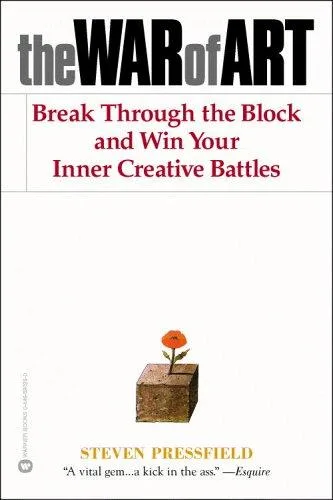
The War of Art
Key Takeaway
The reason you’re not doing your best work isn’t because you lack talent, time, or inspiration. It’s because there’s an invisible force, Pressfield calls it Resistance with a capital R, that shows up every single day to stop you. And until you name it, you can’t fight it.
The Big Picture
- Resistance is the universal enemy of anyone trying to create, build, or become something meaningful
- The difference between amateurs and professionals isn’t skill, it’s that professionals show up and do the work regardless of how they feel
- Inspiration doesn’t precede action. It follows it. The muse rewards those who sit down and start
Why This Book Matters
I’ve talked about this before, in my notes on Atomic Habits, specifically. That stretch where I’d wake up on a Saturday morning fired up, crush it for four hours, feel incredible, and then.. nothing by Wednesday. The energy would evaporate. The plan would collect dust. And I’d wait for the next burst of motivation to carry me forward.
Here’s the thing: I knew the pattern was broken. I just didn’t have a name for what was breaking it.
Pressfield gave me the name. Resistance.
Not resistance as a vague concept. Resistance as an entity. A force with a personality, strategies, and one single mission: to keep you from doing the work that matters. And the moment I started seeing it that way, not as laziness, not as a character flaw, not as “I guess I’m just not disciplined enough”, everything shifted.
Because once you name it, you stop taking it personally. That voice in your head that says you can start tomorrow, you’re too tired, you need to do more research first, you’re not ready, that’s not you. That’s Resistance. And it talks to every single person who’s ever tried to do something meaningful.
This is a short book. Maybe 170 pages. You can read it in an afternoon. That’s a feature, not a bug. Pressfield doesn’t waste your time with filler. He says what needs to be said and gets out of the way, which is, ironically, exactly what the book teaches you to do with your work.
Core Concepts
Resistance (Capital R)
This is the core of the entire book, and honestly, it might be the single most useful concept I’ve gotten from any book on creativity or productivity.
Resistance is the invisible, universal force that opposes any act of creation, growth, or meaningful change. It shows up every time you try to write, build, ship, exercise, have a hard conversation, or do anything that requires you to move from a lower state to a higher one.
It’s not personal. It doesn’t hate you specifically. It opposes everyone equally. Pressfield describes it almost like gravity, it’s just there, pulling against you, and it never takes a day off.
Before reading this book, I assumed the resistance I felt before sitting down to write was some personal weakness. Like other people just.. didn’t feel it. Learning that every creative person fights this same force, every single day, was genuinely liberating. I wasn’t broken. I was in a war. And wars require a strategy, not a pep talk.
Where Resistance Is Strongest
Here’s the part that messed me up: Resistance is strongest where the work matters most.
If you’re not feeling any resistance about a project, Pressfield would say the project probably isn’t important enough. The more something means to you, the more it aligns with your purpose, your growth, your calling, the harder Resistance pushes back.
Think about it. I never feel resistance before scrolling social media. Zero friction. But sitting down to write something honest? Starting a deep work session on the thing that could actually move my business forward? The resistance is massive. It’s like my brain invents seventeen urgent errands the moment I try to do the one thing that actually matters.
That’s not coincidence. That’s Resistance doing its job. And knowing this flips the script, the resistance becomes a compass. The harder it pushes, the more important the work.
The Amateur vs. The Professional
This distinction is the heart of the book’s practical advice.
The amateur plays at their craft. They wait for inspiration. They work when they feel like it. They let Resistance win by telling themselves they’ll start when conditions are perfect, when they have more time, more energy, more clarity, more confidence.
The professional shows up every day regardless of how they feel. Not because they don’t feel Resistance, they feel it intensely. But they’ve made a decision: the work comes first. The feelings are irrelevant.
This hit close to home. I know, from years of personal experience, that once I start writing, I get into flow. The words come. The ideas connect. I lose track of time and look up two hours later having produced something I’m proud of. But the resistance before starting? It’s brutal. Every single time. And the amateur version of me would negotiate with that resistance. Maybe tomorrow. Maybe after I do some research. Maybe once I outline it better.
The professional version sits down and writes a terrible first sentence. And then another. And then suddenly the terrible sentences aren’t terrible anymore, and you’re in the zone you were always going to reach, if you’d just started.
Turning Pro
“Turning pro” isn’t about getting paid. It’s about an internal shift. A decision.
The amateur treats their work as something they do when they feel like it. The professional treats it as a non-negotiable part of their identity. The pro doesn’t debate whether to show up today. That debate is already settled. It was settled the day they turned pro.
This connects directly to James Clear’s identity-based habits from Atomic Habits. Clear says: decide who you want to be, then prove it with small actions. Pressfield says the same thing with different language, decide you’re a professional, then act like one. Both are saying: the decision comes first. The motivation, the confidence, the results, all of that follows. It doesn’t precede.
My morning deep work ritual is my “turning pro” practice. It’s not something I evaluate each morning, should I do it? Do I feel like it? Is today a good day for it? That conversation doesn’t happen. The ritual runs. Period. Some mornings it’s electric. Some mornings it’s grinding. Both count.
Inspiration Follows Action
This might be the most counterintuitive and most important idea in the book.
We’ve been conditioned to believe that creation works like this: inspiration strikes, then you sit down and produce. Pressfield says it’s exactly backwards. You sit down and start working, and then inspiration shows up. The muse doesn’t visit those who wait. The muse visits those who are already at the desk.
I’ve lived this hundreds of times. Zero creative energy, sit down anyway, force out a few bad paragraphs, and then something clicks. An idea I didn’t know I had emerges from the act of writing itself. The work generates the insight. Not the other way around.
Cal Newport describes the same mechanism with his deep work rituals. You don’t wait until you feel focused. You create the conditions, the scheduled block, the shutdown of distractions, the ritual, and the focus follows the structure. Pressfield would call that turning pro. Newport would call that the rhythmic philosophy. Same truth, different vocabulary.
What I’ve Found Most Useful
Naming the enemy. Before this book, resistance was a vague feeling of “I don’t want to.” After this book, it’s a specific force with predictable behavior. And you can’t fight what you can’t name. The simple act of saying “that’s Resistance” when I feel the urge to procrastinate has been more powerful than any productivity hack I’ve ever tried.
Resistance as a compass. The more resistance I feel toward a task, the more I know it matters. This completely reframed how I prioritize my work. The projects I’ve been avoiding? Those are probably the ones I should be attacking first. McKeown’s Essentialism would add: you can’t fight Resistance on ten fronts. Pick the essential work, the one thing that matters most, and go to war on that.
The “motion vs. action” connection. Clear’s distinction from Atomic Habits, motion feels productive without creating anything, is Resistance’s favorite disguise. Research. Planning. Outlining. Organizing your workspace. Buying better tools. All motion. All Resistance wearing a productivity costume. Pressfield helped me see that pattern for what it is: a sophisticated way of not starting.
The daily practice, not the daily feeling. Building a business is a daily war against Resistance. Writing is a daily war. Fitness is a daily war. And in every case, the people who win aren’t the ones with the most talent or the best ideas. They’re the ones who showed up on the days they didn’t feel like it. Goggins fights Resistance with raw intensity, brute-force willpower, suffer through it, never quit. Pressfield fights it with quiet discipline, sit down, do the work, don’t make a big deal out of it. Different energy. Same enemy.
Memorable Quotes
“The more important a call or action is to our soul’s evolution, the more Resistance we will feel toward pursuing it.”
“There’s a secret that real writers know that wannabe writers don’t, and the secret is this: It’s not the writing part that’s hard. What’s hard is sitting down to write. What keeps us from sitting down is Resistance.”
“The professional has learned that success, like happiness, comes as a by-product of work. The professional concentrates on the work and allows rewards to come or not come, whatever they like.”
“Someone once asked Somerset Maugham if he wrote on a schedule or only when struck by inspiration. ‘I write only when inspiration strikes,’ he replied. ‘Fortunately it strikes every morning at nine o’clock sharp.’”
Final Thoughts
Let’s be real: this book has a third section that goes full mystical. Angels. Muses. Higher callings. The idea that when you commit to your work, supernatural forces rally to support you. If you’re wired that way, if the spiritual framing resonates, you’ll love it. If you’re not, you might want to stop after section two and keep the practical gold without the metaphysical layer.
Pressfield also presents a very binary worldview. You’re either an amateur or a professional. You’re either doing the work or you’re not. There’s no middle ground, no spectrum, no “it’s complicated.” Real life has more nuance than that. There are seasons for rest. There are days when the healthy move is to not push through. Not every moment needs to be a battle against Resistance. Recovery matters. Sleep matters. Sometimes the thing Resistance is protecting you from is burnout, not greatness.
But here’s what survives those criticisms, and it survives them easily.
The concept of Resistance, naming that invisible force that stops you from doing your best work, is genuinely life-changing. Once you see it, you can’t unsee it. You’ll recognize it in every procrastination spiral, every “I’ll start Monday,” every research rabbit hole that keeps you from actually creating. And you’ll stop taking it personally. It’s not you. It’s Resistance. It hits everyone. And the only way through it is to sit down and start.
I wrote in my Atomic Habits note that “you cannot build a life on bursts of energy and inspiration, because those are fleeting.” Pressfield would read that and say: exactly, and the thing that makes them fleeting is Resistance. The burst fades because Resistance is patient. It waits. And when the energy dips, it wins, unless you’ve built a professional practice that doesn’t depend on energy in the first place.
That’s the whole message. Don’t wait to feel ready. Don’t wait for inspiration. Don’t wait for the perfect morning, the right mood, the ideal conditions.
Sit down. Start. The muse will find you at your desk.
— filed under programming

David Vo
Writing about mindset, purpose, money, and building with AI, from Montreal. Breaking free from autopilot, one system at a time.
Related book notes
The Laws of Human Nature
You're not as rational as you think. Neither is anyone else. Understanding this changes every interaction you'll ever have.
Meditations
The most powerful man in the world journaling to himself about how to not be an idiot, and somehow it's the most relatable book ever written.