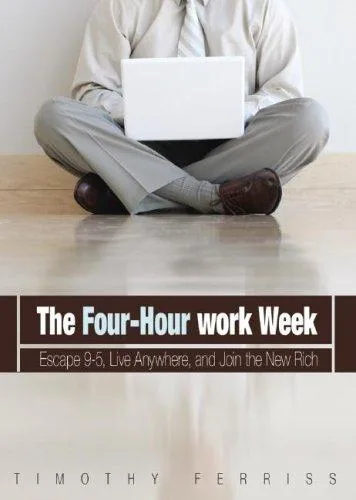
The 4-Hour Workweek
Key Takeaway
The default life script, work 40+ years, retire at 65, then enjoy your freedom, is not a law of nature. It’s a design choice. And you can design something better. The goal isn’t to avoid work. It’s to stop trading your entire life for a retirement that might never come the way you imagined it.
The Big Picture
- The “rat race” isn’t inevitable, it’s a system you can opt out of once you realize it was designed to keep you producing, not living
- Time and mobility are the real currencies of wealth, not salary
- Most of what fills your day is noise disguised as productivity, eliminate it, automate the rest
- You don’t need to wait until retirement to live the life you want. You can take it in pieces, starting now
Why This Book Matters
I need to give you context on where my head was when I first picked this up.
I was on the traditional path. Nursing school. Stable career ahead. Good benefits. The kind of trajectory your parents brag about at family dinners. And on the surface, everything looked right. Steady income. Clear progression. A script that society had handed me, and I was following it line by line.
But something felt off.
Not in a dramatic way. Not a breakdown or a crisis. More like a slow, creeping realization that I was optimizing for someone else’s definition of success. I was building a life that looked good from the outside but felt hollow on the inside. And the worst part? I couldn’t articulate why it felt hollow, because everyone around me was running the same program and calling it normal.
Then I read Tim Ferriss. And the man basically gave me language for what I was feeling.
Here’s the thing: the traditional career path isn’t bad. Nursing is meaningful work. Stability matters. I’m not going to pretend otherwise. But what Ferriss made me realize is that following the default script without questioning it is the real trap. Not the job itself, the autopilot. The assumption that there’s only one way to structure a life: work hard, accumulate, retire, then finally do what you want.
That “then” is doing a lot of heavy lifting. And for a lot of people, “then” never comes.
Think about it. How many people do you know who deferred everything, travel, hobbies, passion projects, rest, until retirement, only to arrive there too tired, too sick, or too disconnected to enjoy it? Bill Perkins makes this exact argument in Die With Zero, and Ferriss was saying it years earlier. Don’t defer your life. Design it now.
That idea cracked me open.
Core Concepts
The DEAL Framework
This is the backbone of the book. Four steps to escape the default life script:
Definition. Redefine what you actually want. Most people say they want to be millionaires, but what they really want is the lifestyle they think a million dollars would buy: freedom, travel, time, experiences. You can often get that lifestyle for far less than you think.
Elimination. Stop doing the 80% of tasks that produce almost no results. This is the Pareto Principle applied to your entire life. Most of your output comes from a tiny fraction of your input. The rest is busy work dressed up as productivity.
Automation. Build systems that handle the repetitive work so you don’t have to. This includes everything from automating your finances (Ramit Sethi’s I Will Teach You To Be Rich is the perfect operational companion here) to delegating tasks that don’t require your specific attention.
Liberation. Free yourself from the location and time constraints of traditional work. Remote work, business design, and lifestyle engineering to give you the mobility and flexibility that most people only get at retirement.
The framework is clean. And the order matters, you have to redefine success before you can eliminate the noise, automate the essentials, and liberate yourself from the default structure.
The “New Rich”
Ferriss draws a sharp distinction between the Deferrers (work now, live later) and the New Rich (design your life now, distribute your adventures throughout it).
The New Rich aren’t necessarily richer in dollars. They’re richer in time and mobility. A person earning $40,000 a year who works remotely from wherever they want and takes a month off every quarter is, by Ferriss’ definition, wealthier than the investment banker earning $500,000 who hasn’t taken a vacation in three years.
That’s a radical reframe. And for someone who grew up equating wealth with salary, because that’s what my environment taught me, it was genuinely disorienting in the best way.
Mini-Retirements vs. Deferred Retirement
This is where Ferriss and Perkins are basically the same person.
Instead of saving everything for one massive retirement at 65, Ferriss argues for mini-retirements, extended breaks of one to six months scattered throughout your working life. Live abroad for a few months. Pursue a project that has nothing to do with income. Recharge before you need to.
Perkins calls this the time-bucket approach, different experiences belong to different life stages, and some have expiration dates. Ferriss operationalizes that same insight: don’t wait. Take the experience now, while your body, energy, and curiosity are at their peak.
I’ve started thinking about this as the anti-FIRE approach. Not anti-saving, anti-deferring. The FIRE community, which I was deep in for years, sometimes falls into its own trap: replace “work until 65” with “deprive yourself until 40.” Different timeline, same fundamental error. You’re still deferring life. You’re still treating the present as a sacrifice for a future that isn’t guaranteed.
The 80/20 Rule Applied to Everything
Ferriss takes the Pareto Principle, 80% of results come from 20% of efforts, and applies it ruthlessly.
Which 20% of your clients produce 80% of your revenue? Focus on them. Which 20% of your tasks produce 80% of your meaningful output? Do those. Everything else? Eliminate or delegate.
Greg McKeown says it differently in Essentialism: “less but better.” Same principle. McKeown gives you the philosophy of doing less. Ferriss gives you the math to justify it. Together, they make a pretty airtight case that most of what fills your day doesn’t actually matter.
Selective Ignorance
Ferriss advocates for a low-information diet: stop consuming news, stop checking email compulsively, stop absorbing information that doesn’t directly contribute to your goals.
This felt extreme when I first read it. But honestly? He’s right more than he’s wrong. The amount of mental bandwidth I’ve recovered by being deliberate about what I consume, whether that’s news, social media, or even podcasts, has been noticeable.
Cal Newport makes a more measured version of this argument in Deep Work. Newport and Ferriss are philosophical opposites in some ways. Newport says go deep, build focus, do the hard thinking. Ferriss says automate, delegate, escape the work entirely. But on this one point they agree completely: most of what competes for your attention is noise. Protect your focus from it.
Lifestyle Design Over Career Climbing
This is the throughline. The whole book boils down to this: design your life first, then build your work around it. Not the other way around.
Most people pick a career, then try to squeeze a life around whatever’s left. Ferriss argues that’s backwards. Define the life you want, where you live, how you spend your time, what experiences matter to you, and then figure out the minimum viable work to support it.
Building my own business was, in retrospect, a lifestyle design decision even before I had the vocabulary for it. I didn’t leave nursing just to make more money. I left because I wanted to build something on my terms, the schedule, the location, the creative freedom. That’s what Ferriss is really selling. Not a four-hour workweek. An intentional life.
What I’ve Found Most Useful
The reframe from “retirement” to “lifestyle design.” Before this book, I thought of life in two phases: working and retired. Ferriss introduced a third option: design a life that doesn’t require retirement because you’re not trying to escape it. That shift in framing changed how I approach every major decision.
The Pareto audit. I’ve done this multiple times, looking at my work, my habits, my relationships, and asking: where is 20% of my effort producing 80% of my results? Every time, I find stuff I should be doing more of and stuff I should have eliminated months ago. It’s embarrassingly clarifying.
The automation mindset. Ferriss and Sethi together gave me the complete picture. Sethi automates your finances, money flows to the right places without intervention. Ferriss applies that same logic to everything else: email batching, task delegation, decision rules that eliminate repeated choices. Build the system once, let it run.
Permission to question the script. This might be the most important thing. Not a tactic. Not a framework. Just the simple, powerful idea that the default path is optional. That you’re allowed to ask “why am I doing this?” and actually change course if the answer isn’t good enough.
Memorable Quotes
“People don’t want to be millionaires, they want to experience what they believe only millions can buy.”
“What we fear doing most is usually what we most need to do.”
“The question you should be asking isn’t ‘What do I want?’ or ‘What are my goals?’ but ‘What would excite me?’”
Final Thoughts
Let’s be real: this book has problems. And I think you need to hear them before you read it, so you can take the good without swallowing the bad.
The 4-Hour Workweek was written in 2007. A lot of the specific tactics, drop shipping, outsourcing to virtual assistants for $4 an hour, the arbitrage plays, feel dated. Some of them were sketchy even at the time. The advice on how to manipulate your boss into letting you work remotely reads more like a con than a career strategy. And the “batching” communication tactics assume a level of workplace autonomy that most people simply don’t have.
Then there’s the credibility issue. Ferriss himself works way more than four hours a week. He’s built a podcast empire, written multiple bestsellers, runs a venture fund, and is involved in dozens of projects. The title is marketing, not reality. He knows it. You should too.
And let’s not pretend his lifestyle is reproducible for everyone. Not everyone can run a supplement company from a beach in Buenos Aires. Not everyone has the savings, the network, or the risk tolerance to blow up their career and start over. Ferriss writes from a position of privilege that he rarely acknowledges, and some of his advice assumes resources that many readers don’t have.
But.
But here’s where I land on it.
The tactics are dated. The philosophy is timeless. The core idea, that you should design your life instead of deferring it, that time matters more than money, that the rat race is a choice and not a sentence, was revolutionary when it was published and it still holds up.
JL Collins in The Simple Path to Wealth tells you to accumulate aggressively so you can buy freedom. Perkins tells you to spend on experiences before the window closes. Ferriss sits in the middle and asks: why not both? Why not design a life where you don’t need to choose between living now and being secure later?
That question changed the trajectory of my life. Not the drop-shipping advice. Not the virtual assistant hacks. The question.
Are you running your life? Or is it running you?
If the answer makes you uncomfortable, good. That discomfort is the autopilot program noticing you’ve reached for the controls.
Pick them up.
— filed under purpose

David Vo
Writing about mindset, purpose, money, and building with AI, from Montreal. Breaking free from autopilot, one system at a time.