The Dip
Key Takeaway
Quitting is not the opposite of success. Quitting the wrong things is a prerequisite for it. The people who win big don’t push through everything. They push through the right thing and abandon everything else.
The Big Picture
- Every worthwhile pursuit has a Dip, a long stretch of hard, unglamorous work between starting and mastery
- The Dip is not a bug. It’s a feature. It’s the barrier that keeps the mediocre out and makes the reward worth having
- Strategic quitting, knowing when and what to quit, is one of the most undervalued skills you can develop
Why This Book Matters
Let me get this out of the way: this book is 96 pages. It’s barely a book. More like a long essay with a hardcover and a barcode. And honestly? That’s a compliment. Godin says exactly what he needs to say and stops. No filler. No padding. No “let me give you twelve more case studies to make the same point.” He respects your time, which is rare in the business book world.
Here’s the thing: I picked this up at a point where I was questioning everything. I’d left nursing. I was building a business. And there were days, a lot of them, where quitting felt like the rational move. Not the emotional move, not the “I’m having a bad day” move, but the calculated, pragmatic, “maybe this just isn’t going to work” move.
The problem was I couldn’t tell whether I was in a Dip or a dead end.
That distinction is everything. A Dip means you’re in the long, hard middle of something worth finishing. A dead end means no amount of effort will change the outcome. Same feeling of frustration. Same exhaustion. Completely different situations requiring completely opposite responses.
Godin gave me the vocabulary to separate the two. And once you have the vocabulary, you start evaluating everything differently. Every struggle becomes a question: is this the barrier that creates value, or is this a wall I’m banging my head against for no reason?
Core Concepts
The Dip
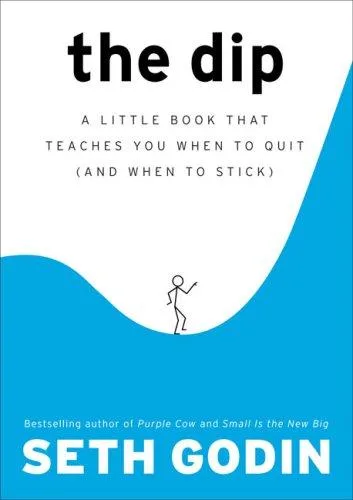
The Dip is the long slog between “this is exciting and new” and “I’m genuinely great at this.” It’s the phase where the initial enthusiasm has worn off, the results haven’t shown up yet, and every fiber of your being wants to move on to something easier.
Think about it. Learning to code: fun for the first week, brutal for the next six months. Starting a business: thrilling when you’re planning, agonizing when you’re grinding through month four with no revenue. Getting in shape: exciting when you buy the gym membership, miserable when you’re still sore and can’t see your abs.
The Dip is where most people quit. And that’s exactly the point. The Dip is a filter. It separates the people who are serious from the people who are just browsing. If there were no Dip, everyone would be an expert at everything, which means expertise would be worthless.
Robert Greene calls this the apprenticeship phase in Mastery. James Clear calls it the Plateau of Latent Potential in Atomic Habits. Clear describes it as invisible progress, the work that’s happening beneath the surface before any results become visible. Godin describes it as the barrier to entry that makes the results valuable. Same phenomenon. Different frames. Both right.
The Cul-de-Sac (Dead End)
This is the concept that changed how I make decisions.
A Cul-de-Sac is a situation where no amount of additional effort will change the outcome. You’re not in a valley you can climb out of. You’re in a circle. More effort just means more laps.
Dead-end jobs. Relationships where both people have checked out. Business models that the market has already rejected. Skills that have been commoditized to the point where mastery doesn’t pay.
The dangerous thing about Cul-de-Sacs is that they feel like Dips. You’re working hard. You’re committed. You’re telling yourself “just push through.” But pushing through a dead end doesn’t get you to the other side. There is no other side.
Godin’s advice is blunt: quit Cul-de-Sacs immediately. Don’t wait. Don’t give it “one more month.” Every day you spend in a dead end is a day you could have spent in a Dip worth surviving.
The Cliff
The third category. Cliffs are situations that feel good, maybe even great, until they suddenly collapse. Think of a career built on a single client who could leave at any time. Or a lifestyle funded by debt. The Cliff rewards you right up until the moment it drops you.
Godin spends less time on this one, and honestly it’s the weakest of the three. But the core insight is useful: not everything that’s working now is safe. Some successes have cliffs baked into their structure. Recognizing them early is the only way to avoid the fall.
Strategic Quitting vs. Reactive Quitting
This is the heart of the book.
Reactive quitting is quitting because you’re in pain. You’re tired. You’re frustrated. The results aren’t coming fast enough. You quit because it feels bad right now, not because you’ve made a clear-eyed assessment that this isn’t the right path.
Strategic quitting is quitting because you’ve determined this is a Cul-de-Sac, not a Dip. You’re not running away from difficulty. You’re reallocating your limited time and energy to something with a better trajectory. That’s not weakness. That’s intelligence.
Here’s how Godin puts it: quitting when you’re in pain is the worst time to make that decision. You should decide before you enter the Dip what conditions would make you quit. Set the criteria when you’re calm and rational. Then, when the pain hits, you have something to check against instead of just reacting to the moment.
Greg McKeown’s “less but better” philosophy in Essentialism is the same idea wearing different clothes. McKeown says quit everything except the one thing worth going all-in on. Godin says quit everything that’s a dead end and pour everything into the Dip worth surviving. Same conclusion. Same strategic ruthlessness about where to spend your finite energy.
Being the Best in the World
Godin makes a bold claim: being the best in the world at something narrow is dramatically more valuable than being pretty good at something broad.
But “the world” is smaller than you think. Your world might be “the best web developer in Montreal who specializes in healthcare startups.” Or “the best book about quitting.” The market is whatever the customer defines as their set of options. If you can be the best option in that set, you win disproportionately.
This connects directly to Cal Newport’s career capital framework in So Good They Can’t Ignore You. Career capital is built by surviving the Dip in a specific domain, accumulating rare skills that most people abandon before they develop. The Dip is the mechanism that makes career capital rare in the first place.
Persistence Through the Dip Is the Scarce Resource
This might be the most important idea in the book, even though Godin doesn’t give it its own chapter.
The scarce resource isn’t talent. It isn’t intelligence. It isn’t access or funding or connections. The scarce resource is the ability to keep going when the Dip is grinding you down. That persistence is exactly what creates value, because it’s exactly what most people can’t sustain.
Newport’s Deep Work makes the same case from a different angle. The ability to sustain deep, focused effort on hard problems is the competitive advantage. Not because focus is some rare gift, but because almost nobody is willing to do it consistently. The Dip and Deep Work are both about the same thing: the willingness to endure what others won’t.
What I’ve Found Most Useful
The Dip-or-Dead-End diagnostic. Every time I feel like quitting something, I stop and ask: is this a Dip I should push through, or a Cul-de-Sac I should leave? That single question has saved me from both premature quitting and stubborn persistence in the wrong direction. It’s not a perfect filter, more on that in a second, but it’s better than making the decision based on how I feel at 11pm on a Tuesday.
The nursing pivot, reframed. Looking back, leaving nursing was the right call. Not because it was hard, everything worth doing is hard, but because I’d determined it was a dead end for me. The work wasn’t leading anywhere I wanted to go. That’s a Cul-de-Sac, not a Dip. But building a business? That was a Dip. The difficulty was the barrier that would eventually make the outcome valuable. Same feeling of struggle. Completely different strategic response.
The “decide before the pain” rule. Setting quit-criteria in advance, before you’re emotional and exhausted, is one of those pieces of advice that sounds obvious but almost nobody does. I’ve started applying this to new projects: before I go in, I write down the conditions under which I’d walk away. When those conditions are met, I quit without guilt. When they’re not met, I keep going without doubt.
Memorable Quotes
“Winners quit all the time. They just quit the right stuff at the right time.”
“The Dip is the long slog between starting and mastery. The Dip is the difference between the easy beginner technique and the more useful expert approach.”
“Quit the wrong stuff. Stick with the right stuff. Have the guts to do one or the other.”
Final Thoughts
Let’s be real: the concept is simple. Almost too simple. Some people will read this in an hour and think, “I paid for that?” And I get it. The Dip, the Dead End, the Cliff. Three concepts. One thesis. Ninety-six pages. There are blog posts longer than this book.
And Godin doesn’t give you a clear framework for distinguishing Dips from Cul-de-Sacs in practice. That’s the hardest part of the whole concept, how do you actually tell the difference when you’re in the middle of it? He hand-waves it. “You’ll know.” “Be honest with yourself.” That’s not a framework. That’s a fortune cookie.
But here’s what survives that criticism: naming the concept is powerful. Before this book, I didn’t have language for what I was experiencing. I just knew that some things were hard and I wasn’t sure whether to push through or walk away. After this book, I had a vocabulary. Dip or Dead End. Two words that restructured how I evaluate struggle.
Sometimes the most useful thing a book can do isn’t give you a system. It’s give you a lens. And this lens, applied consistently, will save you years of effort in the wrong direction and give you the conviction to endure years of effort in the right one.
Quit more. But quit better.
— filed under purpose

David Vo
Writing about mindset, purpose, money, and building with AI, from Montreal. Breaking free from autopilot, one system at a time.