Solve for Happy
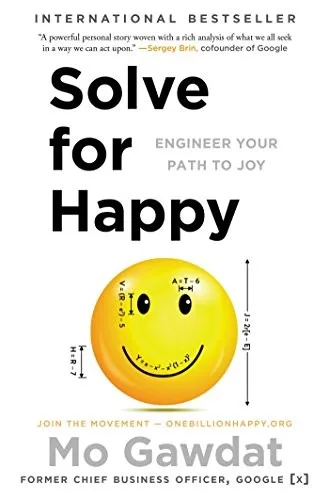
Key Takeaway
Happiness isn’t something you achieve. It’s the default state you return to once you stop running faulty code. Your brain has bugs, distortions in thinking that create unnecessary suffering, and the work isn’t to find happiness. It’s to debug the thoughts that are blocking it.
The Big Picture
- Happiness follows a simple equation: Happiness ≥ Events - Expectations. You’re happy when life meets or exceeds your expectations of how it should be
- Your default state is happy. Unhappiness isn’t the baseline, it’s a malfunction. A bug in your mental code that can be identified, isolated, and fixed
- Six grand illusions and seven blind spots distort your thinking. Learn to recognize them, and most of your suffering dissolves on its own
Why This Book Matters
I need to tell you about the context behind this book before anything else. Because the context is the whole point.
Mo Gawdat was the Chief Business Officer at Google X, the moonshot factory. Brilliant engineer. Wealthy beyond what most people will ever experience. And in 2014, his 21-year-old son Ali died during a routine surgery. A procedure that should have been nothing. And then Ali was gone.
That’s the foundation this book is built on.
This isn’t another Silicon Valley executive selling a productivity framework disguised as wisdom. This is a father who lost his child and turned to the only tool he had left: his engineering brain. He asked, genuinely and desperately, can happiness be solved like an equation? Can I debug my way out of the worst pain a human being can feel?
And here’s the thing: he didn’t write this book after figuring it out from a place of comfort. He wrote it from inside the grief. That distinction matters more than any concept in these pages. Because most happiness books are written by people who’ve never had their world destroyed. Gawdat’s world was destroyed. And he still arrived at this framework. That gives it a weight that pure theory never could.
The core thesis is deceptively simple. Happiness is the default state of the human mind. Not something you earn. Not something you build toward. Not the reward at the end of the achievement treadmill. It’s where you start. It’s where you’d still be if your thinking hadn’t gotten corrupted along the way.
I’ve written before about your mental operating system, the idea that your beliefs are software running in the background, shaping everything you experience. Gawdat’s book is that metaphor made literal. He treats the mind exactly like a codebase. Happiness is the intended behavior. Unhappiness is a bug. And bugs can be found. Bugs can be fixed.
That framing landed hard for me. Not because it’s new, Maltz was describing the same servo-mechanism in Psycho-Cybernetics sixty years ago. But because Gawdat packages it in a language I actually think in. If-then statements. Input-output logic. Default states and error handling. If you’ve ever debugged code at 2am, this book will feel like a familiar process applied to an unfamiliar domain.
Core Concepts
The Happiness Equation
Happiness ≥ Events - Expectations.
Read that again.
You’re unhappy when your experience of an event falls below your expectation of how that event should have gone. That’s it. That’s the entire equation. The gap between what happens and what you think should happen is where all suffering lives.
Your coffee order gets messed up and you’re annoyed. Why? Not because of the coffee. Because you expected the right order. Your project doesn’t get the reaction you wanted. You’re disappointed. Why? Because you expected applause and got silence. The event didn’t change. Your expectation set the bar that reality failed to clear.
This maps directly to what David Robson explores in The Expectation Effect, the research showing that your expectations don’t just color your interpretation of events, they literally shape the events themselves. Gawdat arrived at the same place from a completely different angle. Robson came through neuroscience. Gawdat came through grief and engineering.
And the equation gives you two levers. You can try to change the events, sometimes possible, often not. Or you can examine the expectations. That second lever is always available. Always.
The Six Grand Illusions
Gawdat identifies six illusions that distort how we see reality: thought, self, knowledge, time, control, and fear. Each one is a layer of false code running between you and the world as it actually is.
The illusion of thought is the big one. We believe our thoughts are true because they’re ours. But thoughts are just mental events. They arise, they pass, they’re often completely wrong. Tolle built an entire book around this in The Power of Now, the realization that you are not your thoughts but the awareness behind them. Gawdat is saying the same thing, just in engineer-speak: your thoughts are outputs of a process, not declarations of truth. And sometimes the process has bugs.
The illusion of control hit me personally. We spend enormous energy trying to control outcomes that were never ours to control. The weather. Other people’s opinions. Whether the thing we built will succeed. Gawdat’s argument is clean: control what you can (your effort, your response, your mindset), release what you can’t, and watch most of your anxiety evaporate. Marcus Aurelius was writing that exact prescription in his journal two thousand years ago. Meditations is essentially a nightly debugging session, the most powerful man alive reminding himself what’s in his control and what isn’t.
The illusion of self connects to something Adler explored in a completely different tradition. In The Courage to Be Disliked, Adler argues that all problems are interpersonal, rooted in how you define yourself relative to others. Gawdat takes it further: the “self” you’re defending, the identity you’ve constructed, is itself an illusion. A collection of labels, stories, and roles that you’ve mistaken for something permanent. Loosen your grip on that constructed self, and you loosen your grip on most of your suffering.
The Seven Blind Spots
Where the grand illusions are structural bugs, the blind spots are processing errors. Filters, assumptions, predictions, memories, labels, emotions, and exaggeration. Seven ways your brain consistently distorts incoming data before you even have a chance to evaluate it clearly.
You filter out information that doesn’t match your existing beliefs. You assume your interpretation of a situation is the only valid one. You predict the future based on your worst fears rather than probability. You remember events not as they happened but as you felt about them. You slap labels on people and situations that flatten complexity into cartoon versions. Your emotions hijack your reasoning. And you exaggerate, always, in the direction of drama.
Here’s what I noticed: every single blind spot is something that happens automatically. You don’t choose to filter or assume or exaggerate. The code runs on its own. Which is exactly why it’s so hard to catch. You can’t debug code you don’t know is executing.
The Five Ultimate Truths
After breaking down all the ways your thinking goes wrong, Gawdat rebuilds with five truths he considers foundational: now, change, love, death, and design.
Now is where Gawdat meets Tolle directly. The present moment is the only real thing. Everything else is a mental projection. Gawdat expresses it as code: your brain is running subroutines about the past and the future, burning processing power on simulations. The present moment is the only thing that’s actually executing.
Change is guaranteed. Fighting it is like fighting gravity. Love is the connective tissue between people, not romantic love specifically, but the recognition that isolation is another bug in the system. Death is the ultimate clarifier, the only deadline that matters.
Design is where the book gets spiritual. Gawdat argues that the complexity of the universe suggests an underlying intelligence, a design. This is the chapter where analytical readers might pull back. It’s the furthest the book drifts from its engineering roots, and not everyone will follow him there.
Default Happiness
This is the concept that ties everything together. Gawdat’s central claim: happiness is your factory setting. Watch a child. They don’t need a reason to be happy. They’re happy by default, until something specific makes them unhappy. And even then, they bounce back quickly because they haven’t yet accumulated the layers of faulty code that adults carry around.
Somewhere along the way, you accumulated bugs. Expectations that don’t match reality. Illusions about control and self and time. Blind spots that distort every incoming signal. And those bugs became your normal. You stopped noticing them. You started thinking unhappiness was the baseline and happiness was the exception.
Gawdat says you have it backwards. Happiness is the baseline. Unhappiness is the exception, and it’s caused by identifiable, fixable errors in your thinking.
What I’ve Found Most Useful
The equation as a real-time diagnostic. When I notice I’m unhappy about something, I run the equation. What’s the event? What was my expectation? Almost every time, the suffering isn’t in the event itself. It’s in the gap between what happened and what I thought should have happened. Adjusting the expectation, or recognizing it was unrealistic in the first place, defuses the whole thing.
Treating thoughts as code, not truth. This is the blind spot work in practice. A thought arises: “this isn’t going to work.” Instead of believing it, I treat it like a line of code. Is this logic sound? What data is it based on? Is there a bug here? That tiny pause between thought and reaction is where the debugging happens. Five seconds of inspection can prevent hours of unnecessary suffering.
The default happiness reframe. This shifted something fundamental. I stopped asking “how do I become happy?” and started asking “what’s blocking the happiness that’s already there?” Different question. Completely different set of answers. The first question leads to chasing. The second leads to removing.
Expectation management as a daily practice. Not lowering my standards. Examining them. Are my expectations about this meeting, this project, this conversation based on reality? Or am I setting a bar that guarantees disappointment? This is the simplest, most practical tool in the book. And it works every single time I actually use it.
Memorable Quotes
“Happiness is the absence of unhappiness. Remove the causes of your suffering, and what remains is joy.”
“Your brain is not the problem. The way you use your brain is the problem.”
“The real equation of happiness is not about getting what you want. It’s about wanting what you get.”
Final Thoughts
Let’s be real: this book is imperfect.
The taxonomy feels over-engineered. Six grand illusions and seven blind spots and five ultimate truths. There’s overlap between categories, and by the time you’re sorting your suffering into the correct bucket, you’ve lost some of the simplicity that made the equation powerful in the first place. An engineer’s instinct to categorize everything is both the book’s strength and its weakness.
The later chapters get spiritual in a way that not everyone will connect with. Gawdat’s “design” truth, the argument for an intelligent universe, is a leap that his engineering framework doesn’t fully support. It’s honest. You can tell he believes it. But it’s a different kind of argument than everything that came before it.
And his privilege matters. This is a Google X executive with enormous wealth writing about happiness. Some of his advice, “just adjust your expectations,” hits differently when you’re worried about rent than when you’re debating which vacation to take. He acknowledges this to a degree, but the gap is real.
But here’s the thing. And I keep coming back to this.
This book was written by a man who lost his 21-year-old son. Not a guru selling positivity from a stage. Not a researcher analyzing happiness from a safe distance. A father who experienced the worst thing a human can experience and then sat down, with whatever was left of him, and tried to figure out how to keep living.
That context gives the framework a gravity that most happiness books can’t touch. When Gawdat says happiness is the default state, he’s not saying it from ignorance of suffering. He’s saying it from the deepest suffering there is.
And the core reframe, happiness isn’t something you chase, it’s something you uncover by removing the bugs in your thinking, is genuinely one of the most useful ideas I’ve encountered. It connects to everything. Maltz’s self-image reprogramming. Tolle’s presence practice. Marcus Aurelius’ nightly debugging. Adler’s rejection of the stories we hide behind. Gawdat synthesizes all of it through an engineering lens.
You don’t need to find happiness. You need to find the bugs that are blocking it.
Then fix them. One at a time. Like any good engineer would.
— filed under programming

David Vo
Writing about mindset, purpose, money, and building with AI, from Montreal. Breaking free from autopilot, one system at a time.
Related book notes
The Laws of Human Nature
You're not as rational as you think. Neither is anyone else. Understanding this changes every interaction you'll ever have.
Meditations
The most powerful man in the world journaling to himself about how to not be an idiot, and somehow it's the most relatable book ever written.