The Laws of Human Nature
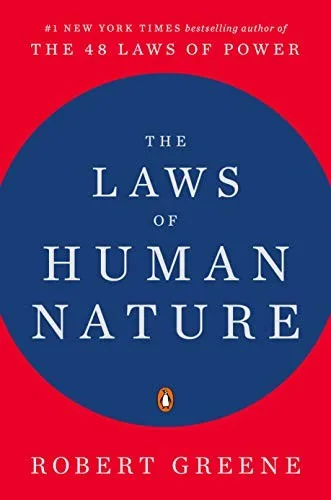
Key Takeaway
Humans are emotional creatures running on ancient programming, and the sooner you accept that about yourself and everyone around you, the better you’ll navigate every relationship, negotiation, and decision in your life.
The Big Picture
- You are far less rational than you believe. Emotions drive roughly 90% of your decisions, and your “logical” mind spends most of its time justifying choices your feelings already made
- Everyone around you is wearing a mask. Learning to read what’s behind it, and being honest about your own, is one of the most valuable skills you can develop
- Understanding human nature isn’t cynical. It’s practical. You can’t navigate a system you don’t understand
Why This Book Matters
I picked this book up because I’d already read Greene’s Mastery and respected how he thinks. Mastery is about building skill. This book is about something harder: understanding people. Including yourself.
Here’s the thing: I thought I was pretty self-aware before reading this. Most of us do. That’s the trap Greene sets in the very first chapter. He opens with the law of irrationality and basically says, “You think you’re the rational one in the room. You’re not. Nobody is.” And then he proceeds to dismantle that belief with 600+ pages of evidence.
What made this book land for me was timing. I was in a phase of building a business, which meant I was navigating more social dynamics than I’d ever dealt with in my life. Different types of people. Different motivations. People who said one thing and meant another. People who supported me to my face and felt something else entirely underneath. I didn’t have a framework for any of it.
I also had to get honest about my own irrationality. When I was still in nursing, I told myself I was staying because it was the smart, stable choice. Logical. Responsible. But the real reason? Comfort. Fear. The devil I knew felt safer than the one I didn’t. That’s not rational decision-making. That’s emotion wearing a rational costume. Greene gave me the language for something I’d already been living but couldn’t articulate.
And then there’s the social environment piece. I watched my own behavior shift dramatically depending on who I was around. With friends who spent everything, I spent. With friends who invested and built things, I invested and built things. I wasn’t making independent, rational choices. I was responding to social cues, mirroring behavior, adapting to the group. Greene would call that the law of conformity at work. I’d call it proof that understanding these patterns isn’t just academic. It’s the difference between being a passenger in your own life and actually driving.
Core Concepts
The Law of Irrationality
This is the foundation. Everything else in the book builds on it.
Greene’s argument is straightforward: you are an emotional creature first and a rational creature second. Your emotions make the decision, and then your rational mind creates a story to explain why the decision was logical. Not sometimes. Almost always.
Think about it. The last big purchase you made. The last time you got angry in a conversation. The last career decision. How much of that was genuinely calculated, and how much was a feeling you reverse-engineered a justification for?
Morgan Housel makes the same point about money in Psychology of Money. His “no one’s crazy” thesis is basically Greene’s law of irrationality applied to financial behavior. People aren’t making irrational money decisions. They’re making emotional decisions and calling them rational. Same mechanism, different domain.
The practical move isn’t to become some emotionless robot. Greene isn’t saying that. He’s saying: notice the emotion first. Give it a few seconds before your rational mind starts building its case. That gap between feeling and reacting is where all the leverage lives.
The Law of Narcissism
Everyone falls somewhere on the narcissism spectrum. That includes you.
Greene distinguishes between deep narcissism, where people are essentially stuck in their own perspective and can’t genuinely see others, and healthy narcissism, where you have enough self-awareness to redirect that energy outward into empathy.
The useful part isn’t diagnosing other people as narcissists. It’s recognizing your own narcissistic patterns. When you’re in a conversation and you’re just waiting for your turn to talk. When someone else’s success triggers something in you that doesn’t feel like joy. When you interpret everything through the lens of how it affects you. That’s the spectrum showing up. And it shows up in everyone.
What I found valuable here was the empathy piece. Greene argues that the highest form of social intelligence is the ability to genuinely step outside your own perspective and feel what someone else is feeling. Not perform empathy. Actually feel it. And that requires recognizing the narcissism first, because you can’t step outside something you don’t know you’re inside.
The Law of Role-Playing
Everyone is performing. Always.
People wear social masks. They present one version of themselves in professional settings, another with friends, another with family. Greene isn’t saying people are liars. He’s saying that social life requires role-playing, and the person who can’t see the performance is at a massive disadvantage.
The practical skill here is learning to read what’s behind the mask. Greene calls it attention to the micro-expressions, the body language, the tone shifts that contradict the words. The moments when someone’s face says something different from what their mouth is saying.
But the part that challenged me more was being honest about my own masks. The version of myself I project when I want approval. The version that shows up when I’m trying to impress someone. Those aren’t bad, exactly. They’re human. But knowing you’re doing it is the difference between performing and pretending.
The Law of Envy
This one is quiet and dangerous.
People will almost never tell you they’re envious. Envy is one of the few emotions humans universally deny feeling. But Greene argues it’s one of the most powerful forces in social dynamics. People sabotage friends, undermine colleagues, and tear down anyone who triggers their sense of inadequacy, all while smiling.
The signs are subtle. Excessive praise that feels performative. Backhanded compliments. People who show up after your success to point out what went wrong. Greene’s advice: when someone close to you starts acting strange after something good happens in your life, don’t dismiss the pattern.
I’ve experienced this in small ways. Not dramatic betrayals, but the energy shift. You start building something, and certain people’s enthusiasm has a hollowness to it. You can feel the gap between what they’re saying and what they’re feeling. Greene taught me not to take that personally. It’s not about you. It’s about their relationship with themselves.
The Law of Shortsightedness
Most people can’t think past next week. Greene says that’s not a character flaw, it’s the default human setting. Our brains evolved for immediate threats and short-term rewards. Long-term thinking is unnatural. It has to be trained.
This connects to every decision I’ve made that mattered. Leaving nursing wasn’t a short-term win. Building a business doesn’t pay off in weeks. Investing doesn’t feel rewarding in the first year. Every significant choice required overriding the part of my brain that wanted immediate gratification for something that would only make sense in years.
Greene’s prescription: train yourself to think in years, not days. Before making any decision, extend the timeline. Ask what this looks like in five years, not five weeks. The people who consistently do this have an enormous advantage over the ones operating in reaction mode.
The Law of Self-Sabotage
Your attitude shapes your reality. Not in some woo-woo, manifestation-board kind of way. In a mechanical, observable way.
If you carry a hostile attitude, you’ll interpret neutral situations as threats. You’ll create conflict where none existed. You’ll push away the people and opportunities that could change your trajectory. The attitude becomes a self-fulfilling prophecy.
This maps directly to Psycho-Cybernetics. Maltz’s self-image is Greene’s law of self-sabotage, just described from a different angle. Your internal model limits your external reality. If your self-image says “I’m not the kind of person who succeeds,” you will unconsciously arrange your life to confirm that belief. Greene is describing the interpersonal version. Maltz is describing the internal version. They’re the same mechanism.
The Law of Generational Myopia
You’re shaped by your generation more than you realize.
The values, anxieties, and blind spots of the era you grew up in are baked into how you see the world. Greene argues that every generation overreacts to the previous one, creating pendulum swings in culture, politics, and values. And most people have zero awareness that their “individual” beliefs are partially a product of generational programming.
This is another form of the autopilot. You think your worldview is independently arrived at. But a significant chunk of it was installed by the time and place you grew up in. Seeing that clearly doesn’t mean rejecting your generation’s values. It means holding them with a little less certainty and a little more curiosity.
What I’ve Found Most Useful
The emotional audit. Before reacting to any charged situation, I pause and ask: “What am I feeling right now, and how is that feeling trying to drive my response?” That gap, even if it’s three seconds, is where better decisions live. It doesn’t work every time. But it works enough to matter.
Reading the room with more resolution. Greene sharpened my ability to notice what people are not saying. The micro-expressions. The energy shifts. The disconnect between words and body language. I don’t use this to be manipulative. I use it to understand what’s actually happening in a conversation, which helps me respond to the real situation instead of the surface one.
Extending the timeline. When facing a decision, I default to asking: “What does this look like in three years?” That single question has saved me from more reactive, short-term choices than I can count. It’s simple. It’s obvious. And almost nobody does it consistently.
Memorable Quotes
“We are all narcissists, some of us just more so than others. The best way to deal with this is to recognize and accept this quality in ourselves.”
“The most common emotion of them all is the desire to feel superior to those around us.”
“Think of it this way: we humans are born with a tremendous potential to understand and influence people. But this potential is dormant. It requires effort, awareness, and practice to develop.”
Final Thoughts
Let’s be real: this is a Robert Greene book. That means it’s 624 pages. Greene does not believe in brevity. He believes in exhaustive historical examples, and then more historical examples after those, and then maybe one or two more just to make sure you really got it.
The historical stories, while genuinely fascinating, can feel excessive. You don’t need three examples from ancient Rome, Renaissance Italy, and 20th-century politics to make each point. One strong example would land just as hard. Greene’s thoroughness is both his strength and his biggest weakness as a writer.
Some of the laws feel like repackaged common sense dressed in academic language. “People are envious.” “People wear masks.” “Most people think short-term.” Yes. But then again, common sense isn’t common practice, and Greene’s frameworks make the invisible patterns visible in a way that general awareness doesn’t.
Here’s the criticism I think is worth sitting with: Greene’s worldview can feel cynical. Even Machiavellian. Reading this book, you might start seeing every interaction as a chess game, every person as a bundle of hidden motives, every relationship as a power dynamic. And that’s… not healthy. Not every conversation has a subtext. Sometimes people are just being people. The book would benefit from more moments of “and sometimes the simplest explanation is the right one.”
It also works better as a reference than a cover-to-cover read. Pick the laws that resonate with where you are right now. Skip the ones that don’t. Come back to the others when life gives you a reason to.
If you’ve read Influence by Cialdini, you have the tactical layer. Cialdini gives you the persuasion mechanics. Greene gives you the why underneath them. Why do these tactics work? Because human nature is predictable in specific, documentable ways. Cialdini is the playbook. Greene is the operating manual for the machine the playbook was designed to run on.
And if you’ve read The Courage to Be Disliked, Adler’s separation of tasks is the perfect counterweight to Greene’s framework. Greene teaches you to understand other people’s irrationality. Adler teaches you to detach from it. You need both. Understanding without detachment makes you paranoid. Detachment without understanding makes you naive.
But here’s what survives all the criticism: the core insight is genuinely powerful. Humans are fundamentally emotional creatures running on ancient programming. That programming drives almost everything we do, from our career choices to our relationships to how we handle money. And understanding that programming, in yourself and in others, gives you an enormous advantage in every area of your life. This is “programming your mind” applied to understanding other minds.
You’re not as rational as you think. Neither is anyone else.
Start there, and everything gets clearer.
— filed under programming

David Vo
Writing about mindset, purpose, money, and building with AI, from Montreal. Breaking free from autopilot, one system at a time.
Related book notes
Meditations
The most powerful man in the world journaling to himself about how to not be an idiot, and somehow it's the most relatable book ever written.
The War of Art
The thing standing between you and your best work isn't talent or time. It's Resistance. And it shows up every single day.