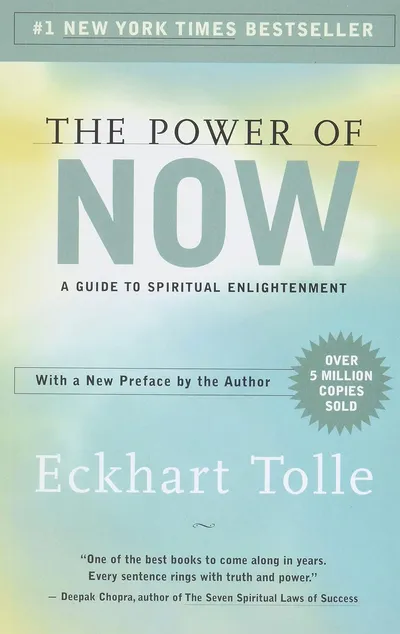
The Power of Now
Key Takeaway
You are not your thoughts. There’s an observer behind the noise in your head, a quiet awareness that watches the thinking without being consumed by it. The moment you realize that, something shifts. Not everything. But enough.
The Big Picture
- The present moment is the only thing that’s real. The past is a memory. The future is a projection. Both are mental constructs, stories your mind tells on repeat
- Most human suffering isn’t caused by actual present-moment problems. It’s caused by mentally time-traveling to places that don’t exist yet or don’t exist anymore
- You are not your mind. You are the awareness behind your mind. That distinction sounds academic until it clicks, and then it changes everything
Why This Book Matters
I need to be upfront about something: this book is polarizing. Tolle’s writing is spiritual, repetitive, and occasionally feels like it’s floating three feet off the ground. If you’re allergic to words like “consciousness” and “being” and “the Unmanifested,” you’re going to have a rough time with this one.
I almost put it down twice.
But I didn’t. And I’m glad, because buried under the spiritual language is one of the most powerful ideas I’ve encountered: the vast majority of your suffering is self-created, and it’s happening because you’re not here.
Think about it. When was the last time you had a genuine, present-moment problem? Not a thought about a problem, an actual, right-now, in-this-second problem? For most people, the honest answer is: almost never. The rent isn’t due right now. The difficult conversation isn’t happening right now. The thing you’re anxious about hasn’t happened yet and might never happen.
But your mind doesn’t care about that. Your mind will rehearse that conversation seventeen times before it happens. It’ll replay that mistake from three years ago while you’re trying to fall asleep. It’ll project worst-case scenarios onto next month while you’re sitting in a perfectly fine Tuesday afternoon.
I hit a period where anxiety about the future was running my days. Career uncertainty, business decisions, the weight of not knowing if I was on the right path. And here’s what I realized: none of that anxiety was about what was actually happening. It was about what might happen. I was suffering in advance for things that hadn’t arrived, and most of them never did.
Seneca said it 2,000 years ago: “We suffer more often in imagination than in reality.” Tolle is saying the exact same thing. Different era, different language, same diagnosis. Your mind is a time machine that almost exclusively visits places that make you miserable.
Core Concepts
The Present Moment as the Only Reality
This is the foundation of the entire book. Tolle’s argument is simple: the past doesn’t exist except as a thought occurring in the present. The future doesn’t exist except as a thought occurring in the present. The only moment you ever actually experience is this one.
That sounds obvious. It’s not.
Because if the present moment is all there is, then most of what we agonize about is literally fictional. The regret about that decision you made last year? That’s a story. The anxiety about what happens if your business doesn’t work out? Also a story. They feel real because your body reacts to them, your chest tightens, your stomach drops, but the events themselves aren’t happening. Your mind is simulating them, and your body can’t tell the difference.
Marcus Aurelius was practicing this 2,000 years before Tolle put a name on it. His nightly journaling was presence practice, bringing himself back to what’s real, what’s in front of him, what he can actually affect. The language is different. The emperor talked about duty and virtue. Tolle talks about consciousness and being. But the practice is identical: stop living in your mental projections and return to what’s actually here.
You Are Not Your Mind
This is the concept that hit me hardest.
Tolle asks a deceptively simple question: can you observe your own thoughts? Can you watch a thought arise, notice it, and let it pass without acting on it?
If you can, and you can, then who is the one watching?
That’s the gap. There’s the thinker, and there’s the observer of the thinker. Most people live entirely identified with the thinker. Every thought that arises, they believe it, react to it, become it. Angry thought? Now you’re angry. Anxious thought? Now you’re anxious. Self-critical thought? Now you feel worthless.
But the observer doesn’t react. The observer just watches. And in that watching, there’s a stillness that the constant mental noise can’t touch.
This isn’t mystical. This is what every meditation tradition has been pointing at for thousands of years. It’s what you experience during deep work, those flow states where time disappears and you’re completely absorbed in the task. You can’t enter flow while mentally time-traveling. Flow is presence. It’s the thinking mind stepping aside and pure awareness running the show.
The Pain Body
Tolle introduces this concept and it’s one of the more unusual ideas in the book, but it stuck with me. The “pain body” is his term for the accumulated emotional pain you carry, old hurts, unprocessed grief, resentment, shame, that lives in you like a dormant entity.
Here’s the unsettling part: the pain body feeds. It seeks out situations that trigger negativity because that’s what sustains it. Ever notice how sometimes you almost want to be upset? How you’ll pick a fight, or dwell on something hurtful, or scroll through content that makes you angry, not because you enjoy it, but because something in you is drawn to it?
That’s the pain body feeding. It thrives on drama, conflict, and victimhood. And once you see the pattern, you can’t unsee it.
I started noticing it in myself. Moments where I’d mentally replay a frustrating interaction not to learn from it, but to feel the frustration again. Moments where I’d catastrophize about the future not because planning was useful, but because the anxiety itself had become a familiar place to live. The pain body doesn’t want resolution. It wants activation.
The Ego’s Need for Identity and Conflict
Tolle defines the ego not as arrogance but as your mind’s compulsive need to identify with things, your job title, your opinions, your possessions, your past, your story.
The ego needs to be right. It needs an enemy. It needs drama to sustain itself. Without conflict, without something to react against, the ego has nothing to do. That’s why people who have “everything” can still be deeply unhappy, the ego keeps manufacturing new problems to justify its existence.
This connected something for me. Those moments when you win an argument but feel empty afterward? That’s the ego getting fed while your actual self gets nothing. The argument wasn’t about truth. It was about the ego’s need to be right.
Surrender and Acceptance
This is where people misunderstand Tolle completely. Surrender doesn’t mean giving up. It doesn’t mean being passive or letting life walk over you.
It means stop resisting what is.
Whatever is happening right now is already happening. Your mental resistance to it, the “this shouldn’t be happening,” the “why me,” the internal argument with reality, doesn’t change the situation. It just adds suffering on top of it.
You get stuck in traffic. That’s a fact. You can sit there peacefully or you can sit there furious. The traffic doesn’t change either way. But your experience of that twenty minutes is completely different.
This principle maps directly onto what Maxwell Maltz describes in Psycho-Cybernetics, his relaxation principle. Maltz found that people achieve their best outcomes not by forcing and straining, but by clearly setting the target and then releasing the tension around it. Stop gripping. Stop forcing. Let the servo-mechanism do its work. Tolle’s surrender is the same muscle. Stop fighting what is and redirect that energy toward what you can actually influence.
The Gap Between Thoughts
Tolle points to something most people have never noticed: there are gaps between your thoughts. Brief moments of silence between one mental sentence and the next.
Those gaps aren’t empty. They’re where you actually are, the awareness that exists before thought fills the space. Meditation is essentially the practice of widening those gaps.
I started with two minutes a day, borrowing the two-minute rule from Atomic Habits. Just sit. Notice the breath. When a thought comes, notice it and return. Two minutes became five. Five eventually became twenty. And in those gaps, there’s a quality of aliveness that the thinking mind can’t manufacture. It’s subtle, but it’s real.
My morning routine became a presence practice. Coffee without the phone. Walks without earbuds. Just being somewhere without needing to be stimulated every second. It sounds like nothing. It changed how I experience my days.
What I’ve Found Most Useful
The “what problem do I have right now” check. When anxiety spikes, I ask myself: in this exact moment, not tomorrow, not next week, what actual problem do I have? The answer is almost always: none. I’m sitting in a chair. I’m breathing. The catastrophe my mind is constructing isn’t here. This single question has defused more spirals than anything else I’ve tried.
Watching thoughts instead of believing them. You don’t have to fight negative thoughts. You don’t have to replace them with positive ones. You just have to see them for what they are, mental events, not facts. A thought that says “this won’t work out” isn’t a prediction. It’s noise. Once you start treating it that way, it loses its power.
The body as an anchor. Tolle suggests using your body as a doorway into presence, feeling your hands, noticing your breathing, sensing the weight of your body in the chair. It sounds trivial but it works because the body is always in the present. Your mind can be in 2019 or 2030. Your body is always here. When I catch myself spiraling, I stop and feel my feet on the floor. That’s it. Instant reground.
Presence as the foundation of everything else. Here’s the connection that tied it all together for me: you can only build atomic habits in the present. You can only do deep work in the present. You can only have the difficult conversation, write the thing, make the decision, all of it happens now or it doesn’t happen at all. Presence isn’t separate from productivity and growth. It’s the prerequisite.
Memorable Quotes
“Realize deeply that the present moment is all you ever have. Make the Now the primary focus of your life.”
“The primary cause of unhappiness is never the situation but your thoughts about it.”
“Rather than being your thoughts and emotions, be the awareness behind them.”
“What a liberation to realize that the ‘voice in my head’ is not who I am. Who am I then? The one who sees that.”
Final Thoughts
Let’s be real: this book could be half its length. The core message is stunningly simple, be present, you are not your thoughts, stop mentally time-traveling, and Tolle takes 230 pages to say it. The Q&A format is uneven. Some questions open up genuinely profound territory. Others feel like filler. And the repetition can test your patience if you’re someone who likes authors to make the point and move on.
Tolle would probably say the repetition is intentional. That you need to hear these ideas multiple times before they move from intellectual understanding to lived experience. He might be right. But it still made me skim sections.
And the spiritual language. If you’re someone who connects with talk about “the Unmanifested” and “the eternal present” and “pure consciousness”, this book will feel like coming home. If you’re not, parts of it will feel like wading through fog. Both reactions are valid. The ideas underneath are the same regardless of the packaging.
Here’s my honest take: if the spiritual framing doesn’t work for you, try Wherever You Go, There You Are by Jon Kabat-Zinn. Same core ideas, presence, observation, non-reactivity, wrapped in a science-based, secular framework. Different vehicle, same destination.
But if you can get past the language, what Tolle is pointing at is real. The realization that you are not your thoughts, that there’s a quiet awareness behind the mental noise that has been there your entire life, is one of the most powerful shifts I’ve experienced. Call it mindfulness. Call it presence. Call it consciousness. I don’t care what label you use. The experience itself is undeniable.
Not everything in this book landed. But what landed, landed hard. And the things I’ve kept from it, the present-moment check, the observer practice, the morning presence routine, have become load-bearing habits in my daily life.
The present moment is the only place anything real has ever happened. You already know this. You’ve just been too busy thinking about yesterday and tomorrow to notice.
Stop thinking about it. Start being in it.
— filed under programming

David Vo
Writing about mindset, purpose, money, and building with AI, from Montreal. Breaking free from autopilot, one system at a time.
Related book notes
The Laws of Human Nature
You're not as rational as you think. Neither is anyone else. Understanding this changes every interaction you'll ever have.
Meditations
The most powerful man in the world journaling to himself about how to not be an idiot, and somehow it's the most relatable book ever written.