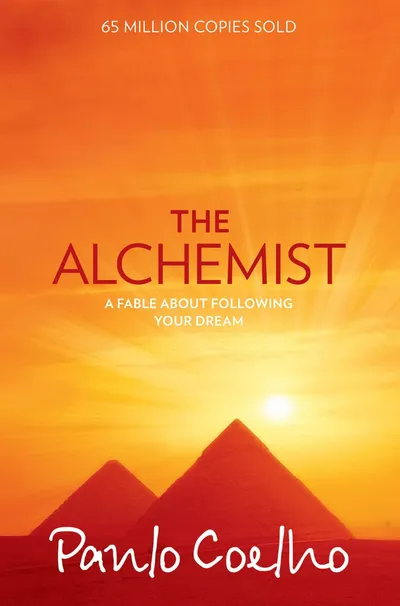
The Alchemist
Key Takeaway
The treasure was at home the entire time. But Santiago had to cross an ocean, sell everything, nearly die in the desert, and fall in love before he could see what was always there. That’s the paradox of purpose, you can’t recognize what you have until you’ve had the courage to leave it behind.
The Big Picture
- Your “Personal Legend” is the thing you’ve always wanted to do, and the universe has a way of testing whether you actually want it
- The journey matters more than the destination, but you won’t believe that until you’ve walked the road yourself
- Fear of failure is real, but fear of never trying is worse, and it’s quieter, which makes it more dangerous
Why This Book Matters For Your Day-to-Day Life
I need to be upfront about something: The Alchemist is one of the most polarizing books you’ll ever pick up. Some people read it and feel like it cracked something open in them. Other people read it and think it’s 160 pages of fortune-cookie philosophy wrapped in a fable.
I land somewhere in the middle. And I think that’s the honest place to be.
Here’s the thing: this book doesn’t give you a framework. It doesn’t give you steps, tactics, or a system you can implement on Monday morning. If that’s what you want, go read So Good They Can’t Ignore You or Atomic Habits. Those books hand you tools. The Alchemist hands you a feeling, this quiet, stubborn sense that you’re supposed to be doing something more with your life than what you’re currently doing.
And sometimes that’s exactly what you need.
I first read it during a season where I was still in nursing, still running someone else’s script, still telling myself the safe path was the smart path. The story of Santiago, a shepherd who leaves everything to chase a recurring dream about treasure at the Egyptian pyramids, hit different when you’re living in your own version of “comfortable but wrong.” I wasn’t a shepherd. But I was definitely tending to someone else’s flock.
The book didn’t tell me what to do. It gave me permission to admit what I already knew, that staying was the riskier choice. Not financially. Emotionally. The kind of risk that doesn’t show up on a spreadsheet but shows up in your chest at 2 AM when the house is quiet and you can’t lie to yourself anymore.
The prose is simple. Some people call that elegant. Others call it shallow. I’d call it efficient. Coelho gets in, delivers the message, and gets out in under 160 pages. In a genre where most authors take 300 pages to say what could fit in 30, I respect the restraint.
Core Concepts
Your Personal Legend
Coelho’s central idea is that every person has a Personal Legend, the thing you were put here to do. Your unique purpose. The calling that’s been whispering to you since before you had the language to describe it.
It’s a beautiful concept. It’s also a dangerous one if you take it too literally.
The danger is in thinking your Personal Legend is some cosmic assignment that the universe will hand-deliver if you just believe hard enough. That’s magical thinking, and magical thinking doesn’t pay rent. But there’s a version of this idea that is useful: the recognition that you have something specific to offer the world, and that ignoring it comes with a cost.
The Japanese call it ikigai, the intersection of what you love, what you’re good at, what the world needs, and what you can be paid for. Coelho calls it your Personal Legend. Different cultures, different languages, same fundamental search. The fact that this idea keeps surfacing across civilizations tells you something. We’re wired to look for it.
But here’s where I diverge from Coelho a bit. Newport would argue, and I think he’s partially right, that “follow your Personal Legend” is just a dressed-up version of “follow your passion.” And passion without skill is just enthusiasm with no leverage. The Personal Legend concept works best when you pair it with the discipline to actually build something worth following. The dream opens the door. The work is what lets you walk through it.
”When You Want Something, All the Universe Conspires to Help You”
This is the line everyone remembers. It’s on mugs, tattoos, Instagram posts. And I have mixed feelings about it.
On one hand, there’s something to it. When you commit to a direction, really commit, not just daydream about it, you start noticing opportunities that were always there. You meet people who can help. Doors appear that you didn’t see before. That’s not the universe conspiring. That’s your brain’s reticular activating system filtering for what you’ve told it matters. It’s psychology, not magic.
On the other hand, the phrasing is dangerous. It suggests that desire is enough. That wanting something hard enough will bend reality in your favor. It won’t. I wanted my business to work. The universe didn’t conspire to make that happen. I stayed up late. I made decisions that scared me. I failed publicly and adjusted privately. The “universe” didn’t do anything, but my commitment created conditions where good things became more likely.
Let’s be real: hard work and smart decisions matter infinitely more than cosmic alignment. But the feeling that the universe is on your side? That’s confidence. And confidence changes how you show up. So maybe the mechanism doesn’t matter. Maybe the belief itself is the point.
The Journey IS the Treasure
Santiago crosses an ocean, gets robbed, works in a crystal shop for months, crosses the Sahara, falls in love, studies alchemy, and at the end, discovers the treasure was buried under the tree where he started. Back in Spain. Right where he began.
It sounds like a cruel joke. But it’s the most honest thing in the book.
You can’t see what you have until you’ve left it. You can’t appreciate home until you’ve been away. The journey doesn’t just take you to the treasure, the journey is what lets you recognize it.
I think about this with Montreal. I’ve lived here most of my life. There were years where I took it completely for granted, the food, the energy, the culture. It wasn’t until I’d gone through the desert of leaving nursing, building something from scratch, questioning everything about the path I was on, that I came back to this city and actually saw it. Same streets. Different eyes.
Bill Perkins argues in Die With Zero that experiences and the journey matter more than accumulation. Coelho would agree completely. But Coelho adds a layer Perkins doesn’t, that sometimes the most important experience is the one that brings you back to where you started, finally ready to appreciate it.
Fear of Failure vs. Fear of Not Trying
There’s a moment early in the book where Santiago is deciding whether to sell his sheep and go to Egypt. He’s comfortable. The sheep are predictable. The life is safe. And the old king Melchizedek tells him that the fear of suffering is worse than the suffering itself.
Read that again.
The fear of what might go wrong if you chase your dream will always feel bigger than the actual consequences of trying and failing. I know this because I lived it. The fear of leaving nursing, of telling my family, of giving up the stability, of potentially failing at something new, was paralyzing. The actual experience of leaving? Hard, yes. But nowhere near as devastating as the story I’d been telling myself.
Frankl came to a similar conclusion from a vastly different angle. In Man’s Search for Meaning, he found that the people who survived the worst conditions were the ones who held onto a reason to keep going. Santiago isn’t surviving a concentration camp, but the principle is the same. Having something worth pursuing gives you the courage to walk through fear. Without that north star, you default to safety. And safety, over a long enough timeline, is its own kind of suffering.
Signs and Omens
Coelho fills the book with signs, omens, and mystical encounters that guide Santiago forward. The recurring dream. The old king. The Englishman’s books. The desert wind. Everything seems to point in one direction if you’re paying attention.
This is where the book gets the most criticism, and honestly, some of it’s fair. Life isn’t a trail of breadcrumbs left by a benevolent universe. Sometimes there are no signs. Sometimes the tea leaves are just tea leaves.
But there’s a practical version of this idea that I do believe in: pattern recognition. When you’re aligned with what you’re supposed to be doing, you start noticing connections that people on autopilot miss. Not because the universe is speaking to you, but because you’re finally listening to yourself. You’re paying attention. And attention is the rarest resource we have.
What I’ve Found Most Useful
Permission to leave the safe path. This book didn’t give me a plan. It gave me permission. Permission to admit that “safe” and “right” aren’t always the same thing. That the discomfort I was feeling in nursing wasn’t a problem to solve, it was a signal to follow. Sometimes you don’t need a framework. You need someone to tell you that the feeling in your gut isn’t wrong.
The reframe on failure. Santiago gets robbed, stranded, and nearly killed, multiple times. Each setback looks like the end. Each one turns out to be a redirection. I don’t think setbacks are always secretly good. That’s toxic positivity. But I do think they reveal things that comfort never could. Building a business has been my desert crossing, the long, grinding middle where you question everything. Coelho prepared me for the emotional shape of that journey, even if he didn’t give me the tactical playbook.
The “already home” insight. The idea that the treasure is where you started doesn’t mean you shouldn’t leave. It means you should leave and come back. The leaving is what gives you the eyes to see what was always there. I use this as a gut-check when I’m chasing something new: Am I running toward something, or running away from something? Both involve movement. Only one leads to treasure.
Memorable Quotes
“And, when you want something, all the universe conspires in helping you to achieve it.”
“There is only one thing that makes a dream impossible to achieve: the fear of failure.”
“People learn, early in their lives, what is their reason for being. Maybe that’s why they give up on it so early, too.”
“Tell your heart that the fear of suffering is worse than the suffering itself.”
Final Thoughts
I didn’t mark this as a must-read. And I want to explain why.
The ideas in this book, purpose, courage, the journey over the destination, are articulated with more depth and more evidence in other books. Ikigai gives you a framework for finding your purpose. Man’s Search for Meaning proves that meaning survives even the worst circumstances. So Good They Can’t Ignore You gives you the mechanics of building a career worth having.
The Alchemist doesn’t compete on depth. It competes on feeling. It’s the book that sits with you on the couch when you’re stuck and says: “You already know what you need to do. Stop pretending you don’t.”
And maybe that’s enough. Maybe not every book needs to hand you a system. Maybe some books just need to stir something in you that’s been sleeping, that quiet voice saying there’s more to your story than the chapter you’re currently in.
If you’re in a season of comfort that feels suspiciously like stagnation, read this book. Not for the philosophy. Not for the prose. Read it for the feeling it leaves behind, the stubborn, inconvenient conviction that you’re meant for something you haven’t started yet.
Then go start it.
— filed under purpose
David Vo
Writing about mindset, purpose, money, and building with AI, from Montreal. Breaking free from autopilot, one system at a time.